This site is an outcome of the Comenius 2008-2010 multilateral project "European Journey Through Legends".

"Becoming more European does not mean forgetting our national cultural heritage, but sharing it with other European nation".

Se afișează postările cu eticheta 04. European Folkstories and European traditions. Afișați toate postările

The legend of “Saint Jordi”

Sant Jordi´s Day
The rose and the book are the main characters of one of the most beautiful hoydays in Barcelona.


The Saint Jordi festivity, which takes place the 23rd of April, is one of the most beautiful holidays in Catalonia, above all in Barcelona. During this day, the downtown streets are full of colours thanks to the small book and rose stands that are put up in the centre. Many curious tourists and neighbours walk through the city. The men must give a red rose as a present to their ladies and the ladies must give a book to their man. This day is also the Day of the Books, which is a remembering of Cervantes death.


The rose tradition is not new. In the Middle Age the aristocratic class organized lord competitions, where the men gave a flower to the women. The red colour symbolizes the passion and the ear that is put together with the rose stands for fertility.

The legend


The Saint Jordi was a lord and a martyr born in Capadocia (Turkish nowadays). He is the hero of an exceptional gentleman story which took place in Libya. As a contradiction to this the Catalonian tradition believes that it happened in Tarragona, in a small town called Montblanc. In Montblanc there was a dragon that feared the people of the town. Its stinky breath managed to kill the people who come close to it.


The neighbourhood wanted to sacrifice one person every day in order to avoid the monster to attack everybody. Naturally the problem was that there was nobody who wanted to be eaten by the dragon. Therefore, each day they picked one person from the population of the town. The system was very effective until one day the person who had to be delivered to the monster was the beautiful princess. Many people offered themselves, but the king was uncompromising in despite of his sadness: His daughter had to be sacrificed like the rest of his citizens.

They were very worried when observing the princess getting closer and closer to the lake, where the dragon lived. A few meters away from were she came from, suddenly a handsome gentleman appeared in front of the princess. She begged him to go away so that the monster wouldn’t eat him too. He calmed her down and explained to her that he was there to free the village.

At this moment, the dragon came out of the ocean depths with the objective of having a good lunch. However, Sant Jordi threw a spear and got to wound the monster. After that, he tied the dragons neck with a rope and offered it to the princess. She came back to Montblanc with the fearful wild animal. At the central square the people definitively killed the animal.


Venice - the town from the heart of water


The Venetian Lagoon

The Venetian Lagoon seen from the Skylab The Venetian Lagoon stretches for 30 miles from north to south, and Venice is in its strategic centre. According to a recent theory the area occupied at present by the waters of the lagoon was once a landmass. Then a combination of natural phenomena operated a dramatic change: the rising of the sea-level and the gradual sinking of landforms - subsidence - caused a rather rapid advance of the sea through disastrous floods. Between the 2nd and 12th C the increase of the sea level has been estimated around 1,80 mt (approx. 6 feet) while landforms had sunk approx. 1,20 mt (approx. 4 feet).


Sand carried down by the rivers and shaped by marine currents eventually formed bands along the coastline, which in due course practically locked the Lagoon in on itself, with the exception of 3 port of mouths. The presence of the caranto as a sedimentary rock, deep into the subsoil of the lagoon, is significant evidence that at one stage there was no water in this area.

A section of the Venetian Lagoon subsoil Information on the lagoon goes back to the 3rd Century: Erodiano, a Roman chronicler reports this lagoon as part of the Seven Seas, a navigable network of waterways along the coastline which connected the city of Ravenna to Aquileia.

Then, more information in 537, in a letter written by Cassiodorus, officer at the Goth's court. The lagoon area is described, the natives' homes dispersed across the surface of the water, boats tied up at the doors. Fish and salt their basic economic resources. Salt being very important, for it was needed to preserve food... So, these boatmen claim our attention as the first people who found a way of making a living in this mixture of mud and water. Yet, we cannot actually refer to these settlements as VENICE. 


“Il Carnevale”

It's been a big dream of every traveller to visit Venice during the Carnival. Buy a mask, put on a long cloak and wander through the early morning mists of the lagoon in late February was my fantasy.  Also take lots of photos for disbelieving relatives back home. This is the best way to celebrate the carnival with the best backdrop in the world!

Venice is a city of fairytales at anytime, but nothing compares to it during the fabulous celebration known as Carnival! It is a city steeped in traditions, a city with a rich history with past intrigues, power and pageantry. I really thought about how much this place is like a movie set. Everything just seemed to be unreal, from the narrow streets to the saturated colors of the buildings.

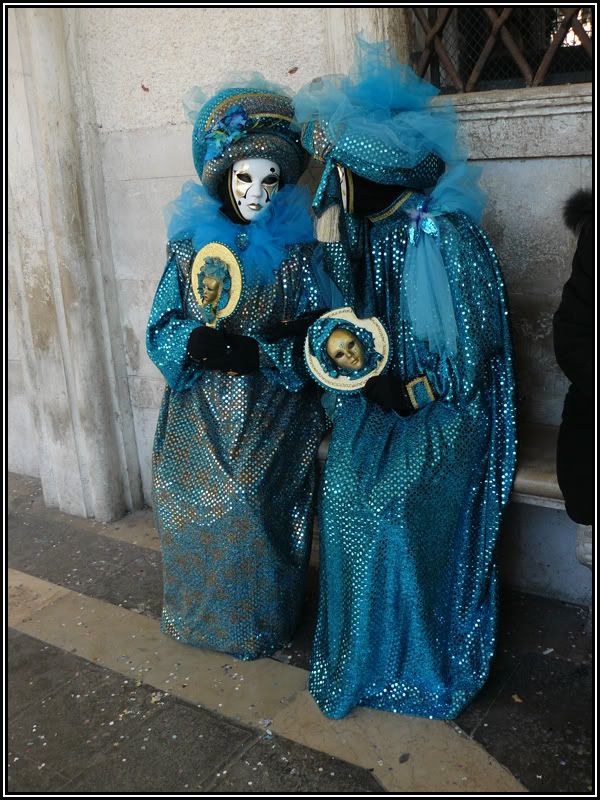
In our February trip to Italy, some of us had the opportunity to spend a day in Venice during "Carnevale". Animation, popular music and dancing bring together locals and visitors. Venice's Carnival took place in this year (2009) in February 14th - 24th. The ceremony for opening the Carnival started with an event called “The Angel’s flight. Another main event is the parade of costumes from Piazza San Marco. The Carnival ends with a impressive fireworks games which is also held in the San Marco Square. We were there in February 15th, the first Carnival’s Sunday. Looking at our pictures everybody could understand the way we felt there. Trying to get around Venice during the Carnival was a real challenge. It seems all the people from the earth were there!

Being there, was an extraordinary experience: for a couple of hours the reality of every day life was replaced with a fun and festive atmosphere. Venice is a magic place, is the perfect place where you could be lost on time and history, through velvet’s masks, black mantles and tricorn hats. 

You could spend a lifetime in Venice, and still not know it. And, I think I'm one of those people, who have fallen in love with a city…Venice.
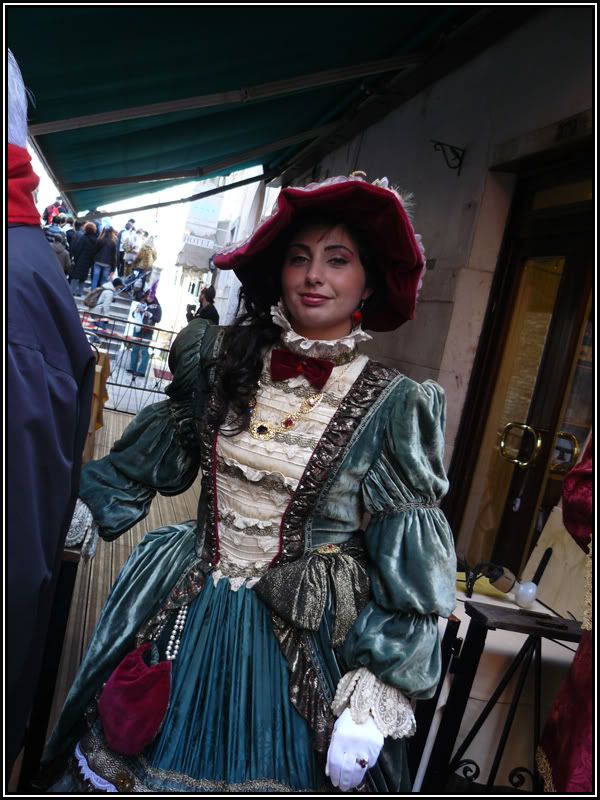
During Carnival the streets are alive, people wearing masks are all over. You could meet harlequins or other masks typical for the “commedia dell'arte” or ladies of the 18th century, or Don Giovanni or the famous Casanova and his beloved Camilla. The City of Venice is a masterpiece born from water. Venice looks like a complicate maze with narrow and gloomy streets, small gardens, colorful boutiques, dark and twisting canals and miniature bridges.

Venice could be visit only by feet or by gondola. All those streets are going to the city center, in San Marco Square, the heart of the town, one of the most beautiful place from entire word. In this charming “plazza”. Who hasn't heard about the romantic “Piazza of San Marco”, “Ponte dei Sospiri” - the bridge of sighs and the Doge’s Palace?

The modern Venetian Carnival culminates on the Tuesday before Ash Wednesday (known as "Mardi Gras"), commencing two Fridays before the Tuesday. Venice carnival dates therefore vary annually, in step with Easter as follows:

Carnival 2007 - February 9-20
Carnival 2008 - January 25-February 5
Carnival 2009 - February 13-24
Carnival 2010 - February 6-16
Carnival 2011 - February 25-March 8


Venice Carnival is steeped in history, charm and tradition: its inhabitants and tourists alike have taken a keen interest in it, thanks to its mix of transgression, art, history and culture in one of the most unique cities in the world.

Where does Carnival come from? And what is it, really? First mention to origin of Venetian Carnival start in the 12th century. The Carnival finished sometimes around 18th century, when Venice has been merged into Austria, and lot of traditions were forbidden. Starting form 1979 the authorities of Venice decided to recreate this lost tradition.

Carnival, or Carnevale, has been celebrated for centuries throughout Italy. Carnival was a pagan ritual marking the end of the old year on winter solstice, the shortest day of the year. With Christianity it became the time when confessions were made in preparation for Lent. And Carnival probably derives from old Italian “Carne levare”, a farewell to meat - and flesh! - before the rigours of Lenten fast. Eventually, it evolved in a relatively short period of merrymaking which reached its climax the day before Ash Wednesday.

Well, in Venice Carnival began on Boxing-day, the day after Xmas, and ended with Mardi Gras...The ceremonies accompanying the event were just extraordinary:

Bullfights in Campo San Polo The flight of the angel was an acrobatic stunt where an equilibrist had to jump from the bell tower, slide on a rope and end in the arms of the doge assisting on the balcony to give him a bunch of flowers. Bullfights instead took place in the campi (the squares of Venice). Consider that in February 1789 the doge Paolo Renier died and the announcement of his death was postponed, so as not to spoil the Carnival!

Venetian Masks But masks and the same gay spirit lasted almost all year round. The mask was used as a disguise to go to parties, brothels, gambling houses, nunneries.
From early date, tourists reporting on Venice included enthusiastic or disgusted comments on her courtesans. The most notorious picture of Venetian licentiousness is to be found in the memoirs of Giacomo Casanova.
Coffee houses multiplied. There were dozen around the Piazza, including Florian which opened in 1720 and Quadri in 1775.

So, 18th C Venice was pervaded by a spirit of festivity, and light-heartedness which derived from the absence of any serious purpose arising from political involvement.

There are many stories regarding wearing masks in Venice. Wearing masks has always been more than just simple fun for the Venetians; it's still a strongly felt tradition with deep cultural roots. Venetians were famous for being libertines and for transgression - they didn't just use masks during the official Carnival. Putting on a mask in Venice meant taking forbidden liberties: you could gamble without being caught, to hide from gambling creditors, to take risks over love or business etc.

Masks made the Venetial carnival unique. If you cannot identify the wearer of the mask, you do not know his social status. In this way Venice temporarily overturned her social order. Laws were passed to limit the wearing of the masks during the carnival period only. If they were worn out of that period severe penalties were enforced.


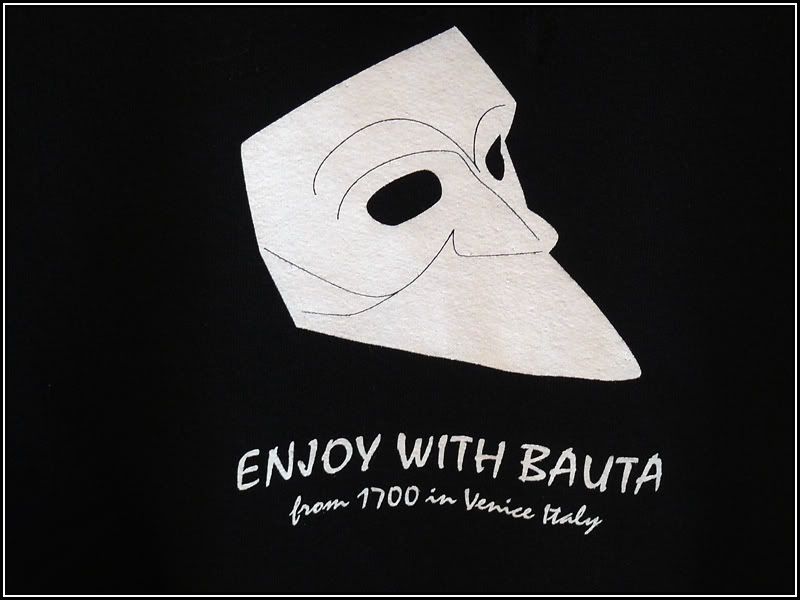
The Bauta (La Bauta)

The etymology of Bauta is uncertain: Tramatar believed it may be derived from the German verb "behüten", that is to protect (the wearer). Alternatively, Durante and Turato refer to the Veneto-Italian "bau-bao", which was a bogeyman like character used by adults as a method to scare children (Danilo Reato). "Se non stai bravo viene il babau e ti porta via." - (trans. "if you do not behave, the babau will come and take you away"). The original elements of the Bauta disguise comprises of the typically shining white face-shaped mask ("larva" or "volto"), a black cape or veil of silk, a cloak (tabarro) or mantle, and a three-cornered ("tricorne") hat. The Bauta was worn by both Venetian ladies and gentlemen alike.

The most traditional type of costumes worn during the long history of Carnival included longnosed masks in black or white, a black cloak or white veil, and a tricorn hat.


The “bauta” is typical mask in Venice during XVIII century. This mask could be wore both during carnival and normal life as common accessory. For many historiographers, Word bauta come from children claims "bau-bau" and for other historians, from "bava" the name of cone of lace in Venetian dialect.

Bauta

This is a "mask which covers the whole face, with a stubborn chin line, no mouth, and lots of gilding.One may find masks sold as Bautas that cover only the upper part of the face from the forehead to the nose and upper cheeks, thereby concealing identity but enabling the wearer to talk and eat or drink easily. It tends to be the main type of mask worn during the Carnival. It was used also on many other occasions as a device for hiding the wearer's identity and social status. It would permit the wearer to act more freely in cases where he or she wanted to interact with other members of the society outside the bounds of identity and everyday convention. It was thus useful for a variety of purposes, some of them illicit or criminal, others just personal, such as romantic encounters.
There are many kind of typical masks. One is "servetta muta" (the silent maid) and this is a little black mask for women with a button to be kept only with the mouth.


Another one has a long nose contained filter prepared with aromatic plants to send away the awful smell of the water from the channels during historical times. Other traditional masks were some masks which were wear by man in the purpose to be disguise with female clothes. 


Strange old times, adventurous lifestyle!


Commedia Dell'arte


Commedia Dell'arte (trans. "comedy of professional artists" or "comedy of humours"), also known as Extemporal Comedy, was a form of improvisational theatre which began in the 16th century and continued to be widely popular up until the 18th century. The performances were improvised by each theatre company around a repertory of stock conventional situations, which tended to revolve around the topics of adultery, jealousy, love and old age.
  • Abadea is the fool who laughed at nothing.
  • Arlecchino (French: Arlequin, English: Harlequin) typically depicted in multicoloured costume comprised of diamond shaped patterns. Painted by Antoine Watteau,
  • Brighella (French: Brighelle), a cunning and mischievous servant. He is associated with Bergamo.
  • Colombina (French: Columbine), maid-servant counterpart of Arlecchino (Harlequin).
  • Il Capitano (the Captain), Cap. Bonbardon, Mala Gamba, Belavita & Zerbino are just some examples of the many forms of the character and Italian masks depicted in the series of 24 etchings, Balli di Sfessania (cerca. 1621) by Jaques Callot.
  • Il Dottore (the Doctor, usually called Dottore Balanzone,  Balordo or Graziano). He is associated with Bologna.
  • Innamorata (the Lover) is the leading woman. She wore no mask (see innamorati).
  • Innamorato (the Lover) is the leading man. He wore no mask (see innamorati).
  • Isabella (Lucinda, Cornelia, Silvia, Rosaura) is Pantalone's daughter.
  • Mezzetino (equivilent of Mezzetin the French figure), painted by Antoine Watteau).
  • Pagliaccio (the Clown).
  • Pantalone or Pantalone dei Bisognosi, (French: Pantalon, English: Pantaloon). He is a Venetian Merchant
  • Pedrolino (or Pierino, most commonly nowadays known as French: Pierrot)
  • Pulcinella (related to the Italian: pulcino or chick) is a crooked-nosed hunchback. He was the model for Punch in the English puppet theatre Punch and Judy. He is associated with Naples.
  • La Ruffiana (Old Woman) is usually a mother or gossipy townswoman who intrudes into the lives of the Lovers
  • Scaramuccia (French: Scaramouche) a roguish adventurer and swordsman who replaced Il Capitano in later troupes.
  • Zanni is a threadbare old servant from Bergamo. He is associated with Bergamo & Venice.


The Winged Lion of Venice


Every city has its distinction; its mark on architecture. For Venice, Italy that mark of distinction is a winged lion. Why a lion when Venice is a maritime city? The symbol does seem an oxymoron but its roots lie deeply in history.


The winged lion was at first St. Mark’s symbol but was later used as the Medici family’s way of showing the power of Venice. Legend tells us that in the Ninth Century some adventurous Venetian thieves stole the remains of St. Mark the Apostle from Egypt. They smuggled the body onto the ship by stuffing flowers and sow meat around the body so as to keep onlookers away. Soon they made it to the vessel and prepared for sail. No sooner than they had made it to the open water, a storm took hold. It was then that St. Mark “appeared” to the captain and warned him to strike the sails lest the ship crash on the rocks. They survived the storm and reached their intended destination. Local Venice religious authorities elected St. Mark as the patron saint of Venice and the winged lion (St. Mark’s traditional symbol) as the logo of the Venetian Republic.


The winged lion, which according to the vision of St. John in the Book of Revelation is the symbol of St. Mark, became the emblem of the city and is to be found everywhere to look after the Venetians. The winged lion is a symbol of peace and is seen in a multitude of other locales such as the Assyrian temple, the Gates of Xerxes at Perespolis, and the Winged lion of Babylon. Today tourists can see winged lions not only as a Venetian symbol of power and prestige, but as a part of the rich heritage and mystique of the city. 


Venice -the Laguna of Love-

It is well known Venice is a town which is define through romance, it's a town of supreme love but also is the town of deepest and cruel love’s betrayals. Of course, this town has many legends and stories. If the stories are true or not is doesn’t matter, Venice still remain a mysterious and very attractive place.


The Gondolier (oarsman) under a Venetian law, must have been born in Venice to become a Gondolier. The oar is held in an oar lock known as forcola. This oar has a complicated shape that allows the Gondola to be steer precisely. It is useed for going forward, turning, slowing down and rowing in reverse. The front ornament known as Ferro has to purposes besides being an ornament; one purpose, is to protect the front from an accidental damage, and the other purpose is to counterweight the front with the back as the Gondolier steers in the back.


Another local legend promises eternal love to couples that kiss in the Gondola under every bridge in Venice, specially the “Bridge of Sighs”. Of course, the bridge of sighs could remind about the agony of love of Casanova - eternally lover.

The Bridge of Sighs (Italian: Ponte dei Sospiri)

This is a bridge in Venice, northern Italy. The enclosed bridge is made of white limestone and has windows with stone bars. It passes over the Rio di Palazzo and connects the old prisons to the interrogation rooms in the Doge's Palace. It was designed by Antoni Contino (whose uncle Antonio da Ponte had designed the Rialto Bridge), and built in 1602.  The view from the Bridge of Sighs was the last view of Venice that convicts saw before their imprisonment. The bridge name, given by Lord Byron in the 19th century, comes from the suggestion that prisoners would sigh at their final view of beautiful Venice out the window before being taken down to their cells. In reality, the days of inquisitions and summary executions were over by the time the bridge was built and the cells under the palace roof were occupied mostly by small-time criminals. Also, they could barely see any view from inside the Bridge due to the stone grills covering the windows.


Those legends makes Venice to be another city of love. There is one legend who tell us Venice has appeared from the water. Unfortunately, this city has an unsure future: the town is sinking into the sea. It seems, this town has the curst and the honor of hard times, but who know, the power of love will save the city.


Saint Mark and the Fisherman

Near the Palace of the Doges in Venice there is a wide marble bridge which is crossed by hundreds of busy feet all day long. But few of the people who pass that way ever notice a little marble picture, close to the pavement, tucked away into a corner of the bridge. It is the picture of a gentle-faced Madonna with her Baby, and underneath are two quaint-looking boats, with some words cut out in the marble.

Sometimes when a gondola goes gliding under the bridge some one with noticing eyes will see the little marble picture and ask the gondolier why it was put there.

"Signorina," says the gondolier, "there is a wonderful and true story about that little Madonna. I cannot tell you the story now because there is so much noise and confusion in these little canals. But some night when we are out on the great lagunes I will tell you why the Madonna and the boats are there."

And this is the story which the gondolier tells under the stars, out on the calm, still water of the lagunes. The far-away lights of Venice shine like a circlet of diamonds with their long reflections in the calm waters. The world seems to our eyes like a crystal globe, for who can tell where the sky begins and the water ends, or which are the most real, the stars overhead, or their twin reflections below? The fireflies come out and breathe and vanish and glow again. A little flame of blue fire breaks the surface of the water as the oar dips down. There is magic in everything around, which well befits the telling of the old Venetian legend.

Long years ago there lived an old fisherman in Venice. He was an honest, hard-working old man, who had nothing in the world but his nets and his fishing-boat. But what more would you have?

At night he tied up his boat under the wide, white bridge, and slept there snugly until the morning. It was as good as a marble palace to him.

Of course there were storms in winter, but his boat was always safe in the shelter of the bridge until one terrible night.

The winter was almost past, for it was in the month of February, when a storm burst over Venice, such as no one had ever seen before, and no one has ever seen since. For three days the storm raged, and the waters rose higher and higher until it seemed as if Venice would be swept from her foundations.

The old fisherman in his little boat was moored as usual under the bridge, but the mad swirl of the waters broke the moorings and he was swept out into the open, and only managed with great difficulty to reach the steps by the Riva of San Marco. There he landed wet through and greatly fearing what would happen next. There was nothing to do but to sit down and wait patiently for the storm to cease, while the angry waves beat against his little boat, and the night grew darker and darker.

Presently, as he sat there alone, a man came down the steps and stood beside him. The old fisherman knew most of the Venetian people by sight, but he had never seen this man before.

"Fisherman," said the stranger, "wilt thou row me across the water to San Giorgio?"

Now the island on which San Giorgio stands was not far off, but between was a grey belt of raging waves lashed ever higher and higher by the fierce gathering storm.

The old fisherman pointed to the waves and then to his little boat.

"How can I row thee across?" he shouted, for he needs must shout to be heard above the roar of the wind; "my boat would be dashed to pieces in a moment, and we would both be drowned."

"I must reach San Giorgio to-night," said the stranger, "and I will pay thee generously."

Well, seeing it was the will of heaven and hearing that he would be well paid, the old fisherman entered the boat with the stranger and managed to push off from the shore. What then was his amazement to find that it was quite easy to guide the boat. The tempest still raged around him, but the waves seemed to spread themselves out in a smooth pathway before them.

It was not long, therefore, before they reached San Giorgio, and there the stranger landed, bidding the old fisherman wait for him.

Presently the stranger came out of the church again and with him came a young knight. He was straight as an arrow, upright as a dart, and his face was very good to look upon, it was so brave and beautiful.

Both the men entered the boat, and the stranger, turning to the fisherman, said quietly, "Now, thou shalt row us over to San Niccolo di Lido."

"But how is that possible?" cried the old fisherman, throwing out his hands. "Even were it fair weather it would be impossible to row so far with but one oar."

"It shall be possible for thee," answered the stranger calmly, "and remember thou shalt be paid generously."

Well, the fisherman looked at the wide stretch of angry waters and then at the quiet face of the stranger, and took up his oar again.

"We shall certainly all be drowned," he said. But he pushed off once more and set out in the direction of San Niccolo di Lido.

And just as it had happened before, the waves spread themselves out smoothly under the little boat, and the fisherman rowed without the slightest difficulty until they came to San Niccolo di Lido.

Then both the men got out, again bidding the fisherman wait for them.

This time they came back with an old man, dressed in the robes of a bishop. He had a kind, gentle face, and even to look at him comforted the heart of the frightened old fisherman.

"Now, row to the gates of the two castles," said the stranger, when all three were safely in the boat.

"But that is the open sea," said the fisherman, trembling with fear; "we shall be certainly overwhelmed."

"Row boldly," said the stranger, "and fear naught."

The winds howled and the waves roared, and the tempest shrieked louder than ever. It seemed impossible that a little boat could live in such angry waters.

And lo! when they came to the gates of the sea, a terrible sight met the eyes of the old fisherman. Sweeping down upon them, full in front, was a huge ship or galley with all sails set. The ship was crowded in every corner with black demons whose shrieks rang even louder than the scream of the wind.

On and on they came, tearing through the waves, and the old fisherman fell on his knees and began to say his prayers, for he thought in another moment his boat would be swallowed up.

But the stranger and the knight and the old bishop rose to their feet, and with uplifted hands they calmly made the Sign of the Cross as the demon ship came near. Instantly the waters grew still, the wind dropped, and the demon ship disappeared with a sound like the crack of thunder.

"Now row us back from whence we came," said the stranger.

And the trembling old fisherman obeyed, wondering greatly what all this could mean. One thing he felt sure of. That demon ship had been on its way to overwhelm and destroy Venice, and he rejoiced to think his beloved city was now safe.

So back they went to San Niccolo di Lido, and there they left the old bishop; then on to San Giorgio, and there the brave knight silently landed.

But when the old fisherman rowed back to the Riva di San Marco, and the stranger was about to land, he began to bethink himself of the promised payment.

"Miracles are wonderful things," he said to himself, "but I want something more than miracles."

So he stood with his hat in his hand, and asked the stranger to pay him as he had promised.

"Thou art right," said the stranger. "I must not forget thee. Thou shalt be well rewarded. Dost thou know for whom thou hast worked to-night? I am Saint Mark, the patron saint of this city. The young knight we took with us was the brave Saint George, and the bishop was none other than the good Saint Nicholas. Together we have saved Venice. For had it not been for us the demons would utterly have destroyed her. To-morrow thou shalt go to the Doge and tell him all thou hast seen, and how Venice was saved with thy help, and he will reward thee."

The old fisherman shook his head.

"And how will the Doge know that I speak the truth?" he asked. For though he held Saint Mark in great reverence, and felt how great an honour it was for the saint to talk with him, he still felt a little anxious about the payment.

Then Saint Mark drew a ring off his finger and handed it to the old fisherman.

"Take this ring," he said, "and show it to the Doge, and tell him I gave it to thee. Then should he still doubt thy word, bid him look in the treasury of San Marco, and he will find the ring is no longer there."

So the old fisherman took the ring and thanked the Saint. And the next day he went as early as possible to the Doge and told him the whole story of what had happened, showing him the ring.

The Doge sent quickly to search in the treasury for the Saint's ring, which was always kept there, but they found it had disappeared. So they were sure that it was Saint Mark himself who had given it to the old fisherman. Whereupon there was a great thanksgiving service held in Venice, and a solemn procession went to each of the three churches, where the bones of the saints were enshrined.

The old fisherman was not only rewarded with gold, but a certain privilege was granted to him. He alone was allowed the right of selling the silver sand from the shore of the Lido. So he grew richer than any fisherman in Venice, but in spite of his riches he always lived in his little boat under the white marble bridge. And when he died the city rulers ordered that little marble picture to be made, with the boats carved beneath it, in memory of the old fisherman who had helped to save Venice that terrible night from the vengeance of the demon crew.

Mărțișor

March The 1st: “Mărțișor”

The tradition has it that the spring and summer weather will be just like the one from this day. March the 1st is related to the custom of “martisor” (diminutive form of martie = March). Folk beliefs say that who wears the “martisor” will be lucky and healthy.

The Little March Amulet

Mărţişor is the symbol of spring and also a celebration on the first of March. Its beginnings are still a mystery. The first evidence of a similar custom come from 8000 years ago. The archeologist have discovered small river rocks painted in red and white that were probably string on a rope and wear as a necklace. Also in ancient Rome, New Year's Eve was celebrated on the 1st of March (Martius), the month of the war god Mars. He had a double role: both protector of agriculture and of war, so the celebration signified the rebirth of nature. The duality of symbols is kept in the colours of the Mărţişor: white and red, meaning peace and war (it might also symbolize winter and spring)
In the old times, the “martisor” was made of two woolen threads, a white one and a red or black one, symbolizing the two main seasons , winter and summer. Women used to make this braid, which they tied on the wrist and neck of their children.

The “martisor” was also worn by young men and adults. Moreover, the braid which announced the spring was tied on the horns of the cows or on the gate of the stable, in order to protect the household. In the old times, March the 1st was the beginning of a new year, moment in which people needed to protect themselves from the evil spirits.

Later, a silver or golden coin, or even a medallion was hanged of the braid, having a protective function. The coins of that braid were kept until St. George (April 23rd) and the girls were buying themselves fresh cheese and red wine, in order to blush as the wine and to be as white as the cheese.

The  “martisor” is worn until the roses or the cherries bloom. Then, the braid is tied on one of the branches of that tree. In other regions, the “martisor” is worn during the ”Old Woman’s days” (March 1st - March 9th), after this being tied on a tree. It is believed that, if the tree gives fruits, the man who has worn the “martisor” will be lucky. If the “martisor” is thrown after a bird, the man will be as easy as that bird.


The Story of the Little March


Once upon a time, there was an old woman. She had a son, March, who had just got married. The old woman didn't like her daughter-in-low maybe because she was too beautiful. That is why she was trying to find a flaw in her son's wife ordering her the most difficult jobs. 

One day the old woman commanded the girl to go to the river and to wash some black wool until it would become white. Without a word the young woman went to the river. There a young man appeared miraculously. He immediately turned the black wool into white one. When he wanted to thank him he disappeared leaving no trace behind him.
Another time, at the end of the winter, in February, the bad old woman asked her daughter-in-low to bring her some wild strawberries. The girl had no choice but to go find the wild fruits. March was desperate because his own mother was torturing his wife. That is why he left his home.
Crying, the girl wandered throws the forest and suddenly the same handsome young boy appeared and filled up her basket with wild strawberries.
The young lady hung at her neck a white coin for the wool and a red one for the wild strawberries.  In her husband's memory whom she is still looking for, she called the coins "Little March". From that day all the "Romanian girl and women wear Little Marches". They believe that the Little Marches bring them luck in love and good health.  


The Legend of the March Amulet


Once upon a time, the Sun embodying a handsome young man, got down from the sky to dance a Romanian round dance (hora) in a village. A dragon lay in wait for him and kidnapped him from among the people and threw him into a jail. The world got sad. The birds wouldn’t flow and the children wouldn’t laugh.  No one dared to challenge the bad dragon. But one day a brave young man decided to go and save the Sun. Lots of people saw him off and shared their strength with him. So they helped him defeat the dragon and save the Sun. His journey lasted for three seasons: summer, autumn and winter. He found the dragon’s castle and they started to fight. They fought for days and finally the dragon was killed.
                             
Powerless and wounded, the young man set the Sun free. The Sun rose in the sky cheering up all the people and filling them with joy. The nature revived, the people got happy, but the young man couldn’t live to see spring coming. The warm blood from his wounds dropped on the snow. While the snow was melting white flowers, called snowdrops, messengers of the spring, were appearing out of the snow. Even his last drop of blood dripped out in the immaculate snow. And he died. Since then the young people have been knitting two little tassels: a white one and a red one. At the beginning of March, they offer this amulet to the girls they love… Red means love for everything that is beautiful. It reminds us of the color of the brave young man’s blood. White symbolizes the pureness and health of the snowdrops, the first flowers that appear in spring.


Dragobete, Romanian Celebration of Love

While Valentine’s Day is mostly related to people (a saint and those he helped) and their actions in the name of love, the Romanian holiday dedicated to love, Dragobete, is strongly connected to nature. Celebrated on February 24th, it is linked to that special time of year when birds build their nests and mate. As the first signs of spring show, nature and man restart the cycle of life and love. What better reason to celebrate? What better reason to sing, dance and kiss girls?

Dragobete, also named Dragomir, is the local counterpart of Roman god Cupid and Greek god Eros. He isn’t however mentioned as a divine creature. He is a positive character, a symbol of pure love, completely opposite to his mother, Dochia. Dochia is said to have been a very cruel mother in law, making a habit of mistreating her daughter in law. She sent her to pick up berries in the month of February, an impossible time of year to find such fruit. God helps the girl in her task fact that leads to a tragedy.

Dochia, believing it was spring already, takes her sheep and her son, Dragobete, up the mountain. Although she carries 12 lambskins in the beginning of her journey, she looses them. The story has two versions here: they either get wet because of the rain or she throws them as it was very warm. Both Dochia and her son freeze to death on the mountain.

However, I like happier myths about who the mother of Dragobete was. One version of the story is of a proud woman, teasing the month of March who then gets even by taking a few days from February. Other stories are of Dochia, sister of Dacian ruler Decebal, who runs away in the mountains to seek refuge from the Roman Emperor Trajan. She disguises herself as a shepherd, but looses her lambskin and freezes. She is then metamorphosed into a stream and her sheep are turned into flowers.

Regardless of its origin, the myth of Dragobete speaks of pristine love, of nature’s rituals translated into people’s life, of new life cycles and of being reborn. It is also said that couples are watching out for which one of them is stepping over the others foot. It is believed that he or she will then take the lead in the couple. 

In the past, on the Dragobete day, the villages  began to play: every boy chasing a girl , she get caught by one she love and even engaged to him. Thus, "Dragobete kissing girls" became the well-known saying.


http://www.rounite.com/2008/02/24/dragobete/

Mrs. Twardowska


Eating, drinking, smoking pipes,
Dancing, laughing, having fun,
They have almost smashed the pub,
Having the time of their lives!

Twardowsky sat down at the table,
And leant his elbows on it
“Enjoy your life” – he said to himself,
Making laugh at everyone.

Had he drunk all vodka from his glass,
It made a terrible sound,
Soon he saw something spooky in it,
And asked - “Why have you come in here?”

It was devil inside,
Who bowed friendly to the guests,
He took off  his hat and jumped of the glass,
Stood steadily on the wooden ground.

“Hello Twardowsky, my friend!”
While saying it, he knocked his heels,
“Don’t you know me? Indeed?”
“I’m Mefistofeles, my dear!”

“Though, it was in Lysa Gora place
Where you have talked to me,
You have signed the pact about a soul
With me and other demons here.”

“In two years’ time
You were to come to Rome,
To let us (devils)
Take your soul away.”

“Seven years have passed since then,
And you haven’t completed it yet,
You are misleading our hell,
Not thinking of visiting this place!”

“But revenge will come even slowly,
Throwing you to our place,
This place is “Rome” called, so
I’m taking you with me to the hell!”

“What should I do?” – Twardowsky is thinking
Getting more nervous and stressed.

Suddenly he’s come up with something new,
To make things even more canny,
“Look at the contract, Mefistoteles
You have promised something to me.”

“After all these years of waiting,
I will have three wishes to ask,
And you will fulfill them all,
With the most difficult tasks.”

“Look!” It’s the emblem of this inn
A horse painted on it.
I want to jump over its saddle
And ride on it even farther!”

“Then make a whip from the sand for me
To lash a horse with it,
And build a house in the forest for me,
To let me relax in it.”

“This house must be made of nuts
As high as Carpathian Mountains.”

Devil is making his wishes come true,
Cleaning and feeding the horse,
Then he made the sand whip
To be ready for further work.

Twardowsky mounted his horse
And tried some jumps and turns,
Then he galloped to check it again
And saw a new pretty place.

“You’ve won, Mefistofeles so far,
But you’ve forgotten about one more task:
You must bath in this basin right now,
It’s holy water inside.”

Devil is drilling and fidgeting
Until he gets really nervous,
But he’s doing what he’s said to
So he’s dipping himself in the water.

Suddenly he jumped from the water fast
He’s shaken and said with a smile
“Now, you’re mine
Cause I did what you asked.”

“One more thing and it’s a deal
(Your devil power will be weak)
Look, it’s a woman,
My wife – Mrs Twardowska”

“I’ll live there instead of you,
Just for a year at Belzebub,
And for this whole year
You’ll stay with my wife as her husband, too.”

“Promise her your love,
Promise her your respect,
Should you break one rule,
It all comes disrespect.”

Devil’s listening to Twardowsky
Pretending to look at his wife
But at the same time,
He’s reaching the door side

Twardowsky is teasing him more,
And makes him go from window to door,
Devil escaped through the key hole
And never returned to his home.

The legend of Mr Twardowski


Mr Twardowski on a rooster, graphic by A. Piotrowski, 1918


The most famous magician in Kraków, Mr Twardowski – so mysterious that the dispute as to whether he was a historical or fictitious person continues to this day – worked on the invention of the philosopher’s stone, which would allow the transmutation of any metal into gold, the rejuvenation of people, and the curing of all illnesses. In return for having all his wishes granted, the magician signed a pact with the devil, to whom he was to offer his soul when in Rome. One of the feats that Twardowski achieved thanks to the devil’s assistance was the building of the Błędowska Desert. The tale makes Twardowski Rocks in Zakrzówek the venue of the School of Witchcraft and Wizardry that Master Twardowski ran. The rocks that received his name are rumoured to have originated on “a bad day” in the laboratory, that is the one when it actually exploded...

Trying to outsmart the devil, Twardowski carefully avoided going to Rome. Nevertheless, one day he guided his steps to a tavern, not knowing that “Rome is the name of that tavern”, and soon saw the devil coming to claim his soul. Not losing his wit, Twardowski quickly jumped on to the back of a rooster, and soared high into the sky. He is rumoured to still be living on the Moon and avoiding Kraków, so that his manservant – disguised as a spider – must spin a silver thread once a month and lower himself down to Kraków, to gather the latest gossip.

The story of a lifetime: The Ethnographic Museum


"Do not forget your past!" it seems this is the motto who guided a common Romanian family through their lifetime. The family Flutur, Aurel and his wife Lucreția,  simple but warm hearted peasants of Chișcău leave behind them a valuable cultural heritage, one of the largest private collection of ethnography in the country which does credits to the community and site host. The village , that crosses Crăiasa (Prices fairy) hill, is located in the picturesque depression of Beiuș, in the foothill of Bihor Mountains in the south eastern part of Bihor county (west side of Romania). Aurel Flutur's passion of collecting objects began in 1968. Nowadays, the collection has over 2500 objects and it is arranged in a peasant farm built in the second half of the twentieth century, that was acquired by the Flutur family in 1981.


There, we have the opportunity to find occupations practiced in rural areas through agricultural machines, tools, presses for grapes, pin, hive, leathers shoemakers, coopers, mining. There are also presented industrial objects, the master piece being a locomobile, dating from 1907.


There are also illustrated home occupations (instruments used in cooking, wooden spoons, various objects used in textiles processing, and clothing manufacturing, distaff, scrubbers, combs, hemp, loom) , folk costumes.


The exhibition space includes various rooms that reconstructs traditional interiors from the area , an old classroom where there is a wooden school bad made by Flutur's  father, the first collected object by him.


A room is dedicated to the memory of the family where there are exhibited vintage photos with family ancestors, objects belonging to Ioan Gabor  the outlaw (1860-1913), Lucreția's grandfather ... one of the last outlaws of Bihor Mountains, whom the olders called Oneață.


The exhibition also present some aspects of religious beliefs and people's lives from the village, a stone altar table dating from 1807, trinitys, wooden crosses and a small collection of history composed of lances and spears from the Middle Ages. Also military objects of modern and contemporary epoque: helmets, suitcases, prosthesis for the war. 


The trail ends with a large hall which hosts a number of heterogenous objects, bells, old phones sets and typewritting machines, abacus, sewing machines, including a wooden one, sledges, decoratives yokes, plows, mills, mobile bread oven, a gypsy wagon and many more...

So, follow the believes of Flutur's family: "Do not forgot your past!"

Evaluation session : Once upon a time in Europe

Learn and play a teathre following the script:

"European Journey Through Legends"


The legend of the Festa de Sant Medir

La Festa de Sant Medir - Fiesta de San Medir is an annual festival every 3rd March in Vila de Gracia area of the Gracia district of Barcelona. It is fondly known as the "La festa més dolça" - "the Sweetest Festival" because of the 100 tons of sweets that are given away every year during the colourful Sant Medir parade. There are various activities, but the biggest event is the evening parade through Gracia. The parade groups (colles) gather on various streets in the "Vila de Gracia" area, the old part of Gracia, then join the procession of horses, carts and lorries down Gran de Gracia to the "Jardinets de Gracia" - "little gardens of Grácia." This is the open area between at the top end of Passeig de Grácia after Av. Diagonal and before Gran de Gracia starts. The evening finishes with a fireworks display. Find parade information links further down this page.


The legend of the Festa de Sant Medir or Sant Emeriterio in Spanish, is about a farmer who became a Catholic Saint in Roman times during the persecution of Christians.

The modern day festival started in 1830 when a baker called Josep Vidal i Granés, who lived in the newly opened street Gran de Gracia. He fell very ill one year and vowed that God would cure him, he would make a annual pilgrimage to the hermitage of his patron saint, Sant Medir.

The hermitage still stands just outside Barcelona on the way to Sant Cugat, where Josep Vidal was originally from. To make public his pilgrimage he would bang a drum and hand out sweets. This was very festive and every year more and more friends and neighbours joined him and this became the first "colla" of the Sant Medir festival. A "colla" is the Catalan name for a group or club.


Today there are thirty "colles" who participate and organise the annual event in the  assocation called "La Federació de Colles de Sant Medir"  - "the Confederation of Sant Medir Colles." The confederation was formed in 1926.


The legend of the Festa de Sant Medir or Sant Emeriterio in Spanish


This popular tradition comes from an important legend that has been passed on from one generation to another. The legend is situated approximately in 300 after Christ and talks about a young peasant called Medir, who lived in a small town near to Barcelona during the Roman Empire of Diocletian. This emperor persecuted fiercely the Christian congregation and ordered to capture the bishop Severe.


The bishop Severe escaped and run away to Sant Cugat. In the way he found the young peasant Medir, who was planting broad beans and who wanted to help the bishop because of his own beliefs. But the bishop told him that the most important is faith and truth and that the peasant should not lie if anyone asked him about Severe.


Soldiers passed by the place where Medir was planting broad beans and asked to him about the bishop. Medir followed the bishop’s advice and said to the soldiers that he saw the bishop to run away while he was planting broad beans, and added that the soldiers could find the fugitive if they went along the road.

As soon as Medir told the truth, a miracle happened: the broad beans that Medir had just planted grew up suddenly and flowered very quickly. Frightened by this event, the soldiers captured Medir and martyred him and the bishop, who was also captured a little bit later.

From then on, when people celebrate Sant Medir, they throw candies and sweets which symbolise the broad beans, for reminding everybody the miracle.

The Blue Charm of Nazar Boncugu

At almost every stages of human history, man has looked for the assistance of magic objects, called talismans to defy evil forces.Talismans with letters, numbers or abstract signs have survived to those days. Even the modern religions with a single god have their own symbols. One of these symbols we find in almost every culture and faith for thousands of years...

Horus' Eye


It's the figure of eye, the blue eye Nazar Boncugu.


Called "Nazar Boncugu" in Turkey, the Nazar, also known as the Evil Eye Stone is a talisman meant to ward off evil and provide protection to the wearer in all aspects of their life. Why is most interesting is that it isn't a folk thing or a rare sighting to see someone wearing it, but it is a prevalent part of Turkish culture. Turkish talisman Nazar Boncugu, is an object which you believe has magic powers to protect you or bring you good  luck.Turkish people believe that it absorbs bad energy coming from evil eyes.

Usualy noone leaves Turkey without purchasing a blue and white nazar boncugu (evil eye charm). You can find them everywhere in Turkey.

Legend said Nazar is something who protects you from "bad luck". Bad luck translates into evil or harm wished upon you from another. People believes that the Evil Eye is a curse, given intentionally or unintentionally by someone else.

The one who bestows the curse is said to look upon, and soon to be afflicted by a person with an evil look, and misfortune will come to those caught in the gaze. Nazar are often given as gifts to friends who have just a baby, or moved into a new house, though sometimes they are given to foreigner as protection during their stay in Turkey.

The people of Turkey are very caution about the Evil Eye, and so, sometimes, one Nazar isn't enought.

It was believed in the ancient times that Tengri Ulgen, god of the skies in Central Asia, would sit in those skies and protect the people from evil. It was for this reason that people considered the colour of the blue skies to be sacred.

When a child is born, an evil eye is pinned to the garment on his or her right back shoulder for protection from other people's evil wishes. No place of business or home is without one. They come in many styles, from simple to ornate. Usually, they are made of glass but also can be made of plastic.

Everywhere you go you will find people wearing the strange amulet; earings, bracelets, necklaces, anklets, charms in all sizes adorn people, their homes, cars and even children in order to protect them from the Evil Eye.


Nazar talismans in the Muslim world are named as "the hand of mother Fatma/Fadime" or, in certain realms of Christianity, as "the hand of Virgin Mother". These hands are nazar beads converge at one place: Egypt.


The Maiden Fair on Găina Mountain

Saint Ilie day traditions
http://www.romania-insider.com/archives/4179


The Romanian Orthodox Church celebrates prophet Ilie on July 20. One of the most important prophets in the Old Testament, Saint Ilie is celebrated as a miracle worker and the one that brings rain during a drought period.

His name comes from the Jewish Elijah, which translates as ‘Whose God is Jah(ve)’, and from the Greek and Latin Elias. In Arabic, the same name is Ilias.

The Romanian tradition labels Saint Ilie as the guardian of crops. It is the popular belief than when it rains with thunders and other spectacular meteorological phenomenons on Saint Ilie’s day, the saint is crossing the skies with his chariot of fire, to protect the living.


According to statistics, there are 120,000 Romanians who celebrate their name day on July 20 (out of a total of around 22 million inhabitants).

It is on Saint Ilie that Romanian peasants are supposed to take the first apple and grape crops and when bee keepers harvest honey for the first time during the year. This day marks the middle of the summer for shepherds, who would come down from the sheep yards to villages for the first time during the year.

The Maiden Fair on Găina Mountain


This is also the period of time when a traditional event takes place in Alba county, on Găina Mountain, in the Apuseni Mountains, a tradition going back two centuries ago. It is called the "Maidens Fair on the Găina mountain" ("târgul de Fete de pe Muntele Găina"), which resides in a traditional matchmaking for young maiden looking for husbands. They would come with their parents and they would display their dower in hand-painted wooden hope chests. The fair also includes a sale of traditional products, like agricultural tools, as well as a banquet with Romanian folk music. The maiden Fair was registered by the Alba county as a trade mark.


THE LEGEND OF THE MAIDEN FAIR ON THE GĂINA MOUNTAIN


Somewhere, a long time ago, both people and gods were sharing the sky and the land, the light and the darkness, the joy and the pain. That is why, up there, at the foot of the clouds, below the holy tear of the sunrise, rolled like a cup of gems over the face of the Mountain which is guarding a bunch of wooden, bricked and stoned houses, lived the “mountaineers”, living pillars of the blue sky wrapping in snow its hidden paths, the roads, the valleys, the woods, with their small horses. There, a small hen had its shelter, making golden eggs and all the “mountaineers” were wondering and wondering and they started to protect her and to devote to thoughts , deeds and songs.

For their golden egg hen they could kill and she was safe from one season to another. Only once a year the “mountaineers” could see her face, her lonely and enigmatical image with her wings open over the vastness.

On the day of the St. Ilie the “mountaineers” were gathering like the rivers in the same bed to tell each other their problems, their hopes and dreams, to offer their children a chance to meet, to fall in love and to propose their hearts to join forever, in marriage. The hen used to descend from her unseen shelter placed on the top of the Mountain. She used to approach the young ones and waving her wings ones she turned into a charming goddess which was approaching the newly married couples with a golden egg in her hands, offering it for happiness and long life. Both people and Mountain were applauding, praying and giving thanks. In the sound of their applause the goddess raised her hands to the sky and turned back into a Hen, hiding herself from the mortals eyes. So the seasons found them, thus starting a habit of faith and love. That’s why, that proud mountain who’s peaks are covered with white clouds, in a height of more then 1500 m was named and forever will be, “The Găina Mountain”.

But the peace, quite and harmony was broken by thoughtless eyes who have forever been trying to discover the nest of the golden Hen and to steal her golden eggs. And finally, with evil’s help, they succeeded. The hen had left her shelter for another festival, on the shoulder of another mountain, having as a purpose the peace of mind of the inhabitants, and some unexpected visitors together with that ruthless man violently searching the nest took the eggs, hid them under his shirt and ran away.


Coming back home and discovering the theft, the goddess was very unhappy and with bitter heart she decided to leave the place forever. She rose her hands high up in the sky, turned into a hen and flew, unseen, to another mountain. And that mountain was at Rosia Montana.

The people mourned her, bagged her to go back to them but the miracle did not happened. Gaina mountain remained behind with barren peaks, haunted by rains, wild winds and snows, by tears and legends. People come to meet the mountain as often as they can, hoping they will be able to tame, to quench its patience, harmony and longing.

They say, the thief that had stolen the eggs fell into a deep strait and the eggs were lost into the depth. They become springs of water or torrents – the crack can be seen today covered by clouds. The Apuseni Mountains and the people living there have been suffering ever since.