It has been determined that the history of Urfa dates back to the Paleolithic Ages between the dates of 500 and 8000 BC. Valuable historical objects have also been found in excavations from the Neolithic Ages between the dates of 7250 and 5500 BC, the Copper Age between the dates of 5500 and 3200 BC and the Early Bronze Age between the dates of 3200 and 1800 BC. It is also thought that the city was established by Prophet Idris (Enoch in Bible) and the Prophet Noah after the flood.
The city of Şanlıurfa and its surrounding region has gone through many dominations including; Sumer, Akkadian, Hittites, Babylonia, Chaldea, Hurrians, Mitanni, Aram, Assyria, Medians and the Persian Empires. Urfa was referred to as Ursu in Hittites' documents in 2000 BC and as Ru'ua in Assyrian documents. Former names of the city before Şanlıurfa include; Ur, Ur of Kalde, Ur of Harran, Orhei, Orhay, Vurhai, Edessa, Diyar-ı Mudar, Ruha, Reha and Urfa.
Alexander the Great invaded Urfa on his Persian Conquest in 332 BC. This invasion was later overturned by Osroene (Edessa) Kingdom in 132 BC. The Osroene Kingdom period, which lasted until 250 AD, played a significant role in Christianity. It is also known that Abgar V. of Edessa (Black Abgar) accepted Christianity as an official religion for his kingdom (one of the first kingdoms which did so), and then further corresponded with Jesus Christ for inviting and spreading the religion to the region. In return Jesus Christ sent a letter to Abgar Ukomo and also a towel expressing his blessing for the city. After wiping his face with the towel (The Medallion), a portrait of his face miraculously appeared on the towel. This phenomenon helped make Urfa a present day holy land for Christians. It's believed that the holy towel has been protecting city for years. In 944 AD, eastern commander of the Byzantine Empire John Kourkouas invaded Urfa, obtained the towel and brought it back to Istanbul with a glorious ceremony.
After the acceptance of Christianity in its early years, Urfa accepted Islam in 639 AD. Until the encirclement of Seljuk Sultan Alp Arslan in 1077, when the land became an independent crusader state or the country of Edessa (1098-1144), Urfa has been a stage for many religious and political acts, Urfa was ruled by Zengi in 1444 and by Saladin in 1182. After the two Mongol Invasions in 1240 and 1250, Urfa was ruined by Hulagu Khan.
Urfa was ruled by Aq Qoyunlu Turcomans in 1404, Safavids in 1514 and at last by the Ottoman Empire in 1517. The British army invaded the city on March 24, 1919 and the French invaded on October 30, 1919. After a strong defense by the citizens of Urfa, the French armies succeed on April 11, 1920.
Prophet Abraham (Ibrahim)
Nemrut is a ruler who spreads terror and fear all around. One night he asks for an interpretation of his dream. King Nemrut had a dream, in which he loses his kingdom,
“This year a child will be born and he will destroy your heathen religion and kingdom...”
Upon this dream King Nemrut decided to kill every child born within that year. Sara, pregnant to Prophet Abraham, hid her pregnancy and gave birth to Abraham in a cave secretly. The cave where Prophet Abraham was born is inside the Mevlid-i Halil Mosque. So, Sara, mother of the Prophet Abraham, gives birth to her child in a cave, leaves him there and goes home. A gazelle nurses the baby. After awhile, soldiers find Abraham in the cave. Prophet Abraham lived in that cave for 7 years furtively. Nemrut, who never had a child, decides to take care of Abraham.


After the age of 7, he was brought back to his father’s house and after growing up he had struggled against the heathen people. He expressed his beliefs that their belief in the different gods was not correct; he repeatedly expressed there is only Allah who created the universe.
Witnessing the horror of Nemrut forcing his people to worship statues, when everyone leaves for a ceremony, Abraham enters the area of statues in the palace and breaks all the statues with an axe, finally leaving the axe in the hands of the largest statue. During his trial, Abraham protests his innocence, saying ?You see the axe is in the hands of the big statue; probably he is the one who did it.? Furious, Nemrut shouts, ?How can a piece of stone take an axe and do this?? Abraham replies: If he is a real God, why can?t he do it?? Infuriated, Nemrut commands Abraham to be thrown into the fire. Although Zeliha, daughter of Nemrut, begs for mercy, she can't convince her dad.
Wood is piled up in the area of Halil-ul Rahman Lake and the fire is set. Nemrut soon after captured the prophet and threw him into the flames over the Castle of Urfa. At that moment, Allah ordered that “All the flames! Be cool and safe for Abraham.” The place where the Prophet Abraham fell into the fire becomes a lake and a rose garden and the woods become fishes. Since that day the area in Urfa called Balıklı (Fishy) Lake is considered to be holy ground.


The small lake located next to Balıklı Lake is called “Ayn-Zeliha”, or Zeliha's Eye, referring to Nemrut's daughter Zeliha, who cried for Abraham and whose tears then turned into a lake.



Prophet Job (Eyyub)
As the story goes, Allah had taken all of the children and goods of Prophet Job and then gave him an illness to make prove his loyalty. Worms covered his entire body, as he laid a cave; during this Prophet Job never rebelled against Allah. He continued his devotion; waited patiently and thanked god. Because of his patience Allah then gave him his goods and health back. The cave in which the prophet suffered his illness and the well where he washed himself with the blessed water is currently open to visitors in the Eyyub Peygamber district in Urfa. Prophet Job's tomb is also located in Eyyub Nebi Village about 20 kilometers outside Urfa. Also on the skirts of the Viranşehir district is mausoleum of Prophet Job, his wife Rahme's tomb and the location where Prophet Eliseus died.
Prophet Eliseus ( Elyasa )
Prophet Eliseus sought to visit Prophet Job however he believed that he was far from Prophet Job was. One day as he set out to take the journey to reach Prophet Job, the devil (Şeytan) appeared in front of him, lied to him about the distance and told him that he still had a long journey to reach Prophet Job. Eliseus was very old at that time and prayed to Allah to take his life away and so he did. Today his tomb is located in Eyyubi Nebi village located in Şanlıurfa, it is just 1 kilometer from the tomb of Prophet Job.
Prophet Shoaib ( Şuayb )
It is believed in that Prophet Shoaib was living in ancient city of Şuayb, located 85 km from eastern Urfa. A cave-house in the ruins of this ancient city is open for visitors as his house.
Prophet Noad ( Nuh )
After the flood, its believed that Noah's Ark landed in Mount Cudi, located between Urfa and Ceylanpınar. ( Re'sulayn ) This mountain has a strange surface; which looks just like the waves of a sea. The mountain is located in the same place as the ancient cities Soğmatar and Şuayb.
Prophet Moses (Musa)
Prophet Moses' well and a sign of his staff is located in the ancient city of Soğmatar, currently the area of Soğmatar is known as Yağmurlu Village.
Prophet Lot (Lut)
Prophet Lot, the son of Harran, brother of Prophet Abraham, immigrated with his uncle Abraham to the Sodom, where he was assigned as a prophet. He was born in Urfa and spent his childhood with Prophet Abraham. Prophet Lot lived with Prophet Abraham in the Harran region.
Prophet Jacob (Yakup)
It is thought that he lived in a building called Deyr Yakup (The Throne of Nemrud) in the eastern of Urfa, about 10 kilometers outside the city.
The city of Şanlıurfa and its surrounding region has gone through many dominations including; Sumer, Akkadian, Hittites, Babylonia, Chaldea, Hurrians, Mitanni, Aram, Assyria, Medians and the Persian Empires. Urfa was referred to as Ursu in Hittites' documents in 2000 BC and as Ru'ua in Assyrian documents. Former names of the city before Şanlıurfa include; Ur, Ur of Kalde, Ur of Harran, Orhei, Orhay, Vurhai, Edessa, Diyar-ı Mudar, Ruha, Reha and Urfa.
Alexander the Great invaded Urfa on his Persian Conquest in 332 BC. This invasion was later overturned by Osroene (Edessa) Kingdom in 132 BC. The Osroene Kingdom period, which lasted until 250 AD, played a significant role in Christianity. It is also known that Abgar V. of Edessa (Black Abgar) accepted Christianity as an official religion for his kingdom (one of the first kingdoms which did so), and then further corresponded with Jesus Christ for inviting and spreading the religion to the region. In return Jesus Christ sent a letter to Abgar Ukomo and also a towel expressing his blessing for the city. After wiping his face with the towel (The Medallion), a portrait of his face miraculously appeared on the towel. This phenomenon helped make Urfa a present day holy land for Christians. It's believed that the holy towel has been protecting city for years. In 944 AD, eastern commander of the Byzantine Empire John Kourkouas invaded Urfa, obtained the towel and brought it back to Istanbul with a glorious ceremony.
After the acceptance of Christianity in its early years, Urfa accepted Islam in 639 AD. Until the encirclement of Seljuk Sultan Alp Arslan in 1077, when the land became an independent crusader state or the country of Edessa (1098-1144), Urfa has been a stage for many religious and political acts, Urfa was ruled by Zengi in 1444 and by Saladin in 1182. After the two Mongol Invasions in 1240 and 1250, Urfa was ruined by Hulagu Khan.
Urfa was ruled by Aq Qoyunlu Turcomans in 1404, Safavids in 1514 and at last by the Ottoman Empire in 1517. The British army invaded the city on March 24, 1919 and the French invaded on October 30, 1919. After a strong defense by the citizens of Urfa, the French armies succeed on April 11, 1920.
Why is Şanlıurfa named the City of Prophets?
Prophet Abraham (Ibrahim)
Nemrut is a ruler who spreads terror and fear all around. One night he asks for an interpretation of his dream. King Nemrut had a dream, in which he loses his kingdom,
“This year a child will be born and he will destroy your heathen religion and kingdom...”
Upon this dream King Nemrut decided to kill every child born within that year. Sara, pregnant to Prophet Abraham, hid her pregnancy and gave birth to Abraham in a cave secretly. The cave where Prophet Abraham was born is inside the Mevlid-i Halil Mosque. So, Sara, mother of the Prophet Abraham, gives birth to her child in a cave, leaves him there and goes home. A gazelle nurses the baby. After awhile, soldiers find Abraham in the cave. Prophet Abraham lived in that cave for 7 years furtively. Nemrut, who never had a child, decides to take care of Abraham.


After the age of 7, he was brought back to his father’s house and after growing up he had struggled against the heathen people. He expressed his beliefs that their belief in the different gods was not correct; he repeatedly expressed there is only Allah who created the universe.
Witnessing the horror of Nemrut forcing his people to worship statues, when everyone leaves for a ceremony, Abraham enters the area of statues in the palace and breaks all the statues with an axe, finally leaving the axe in the hands of the largest statue. During his trial, Abraham protests his innocence, saying ?You see the axe is in the hands of the big statue; probably he is the one who did it.? Furious, Nemrut shouts, ?How can a piece of stone take an axe and do this?? Abraham replies: If he is a real God, why can?t he do it?? Infuriated, Nemrut commands Abraham to be thrown into the fire. Although Zeliha, daughter of Nemrut, begs for mercy, she can't convince her dad.
Wood is piled up in the area of Halil-ul Rahman Lake and the fire is set. Nemrut soon after captured the prophet and threw him into the flames over the Castle of Urfa. At that moment, Allah ordered that “All the flames! Be cool and safe for Abraham.” The place where the Prophet Abraham fell into the fire becomes a lake and a rose garden and the woods become fishes. Since that day the area in Urfa called Balıklı (Fishy) Lake is considered to be holy ground.

This large rectangular pool is known as Abadur Rahman Havuzu, and contains hundreds of 'sacred' carp. Legend has it that anyone who eats the fish will go blind. This has resulted in an over population of the fish , which are now believed to be cannibalistic.


The small lake located next to Balıklı Lake is called “Ayn-Zeliha”, or Zeliha's Eye, referring to Nemrut's daughter Zeliha, who cried for Abraham and whose tears then turned into a lake.



The Halil-ür Rahman Mosque, built by Salahaddin Eyyubi's nephew Melik Eşref in the year 1211 and located right next to Balıklı Lake, serves as an architecturally and aesthetically pleasing companion to the natural beauty of the lake.
Islamic legend tells a similar story, but with the added twist, that the sadistic Nemrut catapults Abraham from a giant sling shot situated high on the citadel, into the burning fire. The sling is represented by the 2 corinthian columns at the entrance to the kale.


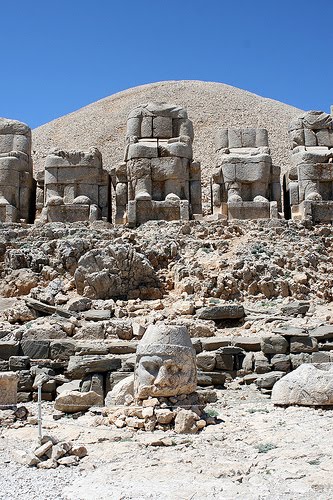
When King Antioch decided to build a giant cemetery-monument complex surrounded by three tall statues during his reign 2000 years ago, the 30-degree weather conditions and limited construction time did not stand in the way of his ambitions. Antioch's architects and workers constructed and chiseled giant stone chunks into three large atriums or terraces facing east and west. Huge statues, reaching seven to eight meters high, were then built on these terraces. Antioch also commissioned a “Pantheon,” or a gallery for the gods, for himself and his close ones. He aimed to immortalize his kingdom as a nation of the gods on Nemrut's hill in the name of the god Zeus. It will come as no big surprise that over the centuries the statues crumbled, some disappeared outright, while others were damaged to such an extent as to be unrecognizable. The statues of the gods' heads are still there. For 2000 years they have been watching the meadows of Anatolia from the peaks of Nemrut Mountain.


Prophet Job (Eyyub)
As the story goes, Allah had taken all of the children and goods of Prophet Job and then gave him an illness to make prove his loyalty. Worms covered his entire body, as he laid a cave; during this Prophet Job never rebelled against Allah. He continued his devotion; waited patiently and thanked god. Because of his patience Allah then gave him his goods and health back. The cave in which the prophet suffered his illness and the well where he washed himself with the blessed water is currently open to visitors in the Eyyub Peygamber district in Urfa. Prophet Job's tomb is also located in Eyyub Nebi Village about 20 kilometers outside Urfa. Also on the skirts of the Viranşehir district is mausoleum of Prophet Job, his wife Rahme's tomb and the location where Prophet Eliseus died.
Prophet Eliseus ( Elyasa )
Prophet Eliseus sought to visit Prophet Job however he believed that he was far from Prophet Job was. One day as he set out to take the journey to reach Prophet Job, the devil (Şeytan) appeared in front of him, lied to him about the distance and told him that he still had a long journey to reach Prophet Job. Eliseus was very old at that time and prayed to Allah to take his life away and so he did. Today his tomb is located in Eyyubi Nebi village located in Şanlıurfa, it is just 1 kilometer from the tomb of Prophet Job.
Prophet Shoaib ( Şuayb )
It is believed in that Prophet Shoaib was living in ancient city of Şuayb, located 85 km from eastern Urfa. A cave-house in the ruins of this ancient city is open for visitors as his house.
Prophet Noad ( Nuh )
After the flood, its believed that Noah's Ark landed in Mount Cudi, located between Urfa and Ceylanpınar. ( Re'sulayn ) This mountain has a strange surface; which looks just like the waves of a sea. The mountain is located in the same place as the ancient cities Soğmatar and Şuayb.
Prophet Moses (Musa)
Prophet Moses' well and a sign of his staff is located in the ancient city of Soğmatar, currently the area of Soğmatar is known as Yağmurlu Village.
Prophet Lot (Lut)
Prophet Lot, the son of Harran, brother of Prophet Abraham, immigrated with his uncle Abraham to the Sodom, where he was assigned as a prophet. He was born in Urfa and spent his childhood with Prophet Abraham. Prophet Lot lived with Prophet Abraham in the Harran region.
Prophet Jacob (Yakup)
It is thought that he lived in a building called Deyr Yakup (The Throne of Nemrud) in the eastern of Urfa, about 10 kilometers outside the city.


