This site is an outcome of the Comenius 2008-2010 multilateral project "European Journey Through Legends".

"Becoming more European does not mean forgetting our national cultural heritage, but sharing it with other European nation".

A Piece of European Treasure

A Proposal for an European Interdisciplinary Curriculum


I. Curricular areas involved :


1.Languages and communication (national languages, English)
2.People and society (history, geography, biology,ecology,religion)
3.Arts.Technology (ICT)

II. Argument

One of the main values that guide human life in the era of globalization is creating a favorable environment for a sustainable development based on the balance between man and nature, the harmony between social needs and economy and cultural activities.


This proposal for an optionally curriculum is inspired by the activities developed during implementation of the Comenius 2008-2010 multilateral project "European Journey through Legends" developed under the European LLP programme frame. This curriculum is a highly interdisciplinary one, and can be used for expanding students' knowledge in natural sciences, geography, history, civics,  Romanian, Polish, Greek, Turkish, Italian, Spanish but also English language and literature, art, and technology. The proposed activities are practical, and those allow to combine physical labor with intellectual development and contribute to the moral, aesthetic and vocational development of students. Using different pedagogichal approaches such us learning through drama, outdoor education or ICT into lessons the learning enviroment will be a new one where subjects as ICT or art are the focal point of the intercultural dimension of education.


Human impact on the environment must be determined by the idea of maintaining balance in nature. In this sense, knowledge of the landscape is important as a basic feature of this interaction. By focusing on this issue we will contribute to knowledge, to preserve and to sustain the development of European landscapes. In terms of teaching the landscape is very interesting  and can be used as a source of a modern and interdisciplinary approach.


The opportunities to enact feelings, human emotions and to arouse children's fantasy and creative spirit, make them actively participate in educational activities, are endless. For child this is a fun, but for an adult this is an opportunity to watch how the child's personality develop, an opportunity to stimulate and to influence the development of his personality.


The artistically moments prepared and played during the activities of this curriculum can contribute to educating the feelings of friendship, the spirit of mutual assistance, the perseverance, honesty, initiating students as the filmmakers/ actors/ spectators. Working in teams, students will develop and will show their inclinations and skills,  will gain confidence in their capabilities. Talking in terms of personality,children can be known who they are, they can change themselves, (re)form and complete each others.


This curriculum's aims are the training of children to have a wide general knowledge, to be able to understand the world around them, to communicate and to interact with peers by expressing thoughts, moods, feelings, opinions, to be sensitive and to use effectively their creative skills, to be able to preserve and to create beauty around them.

III. General competences:

The main aim of this curriculum is to give true meaning to building Europe, through different lessons into a non-formal learning environment, trhough shared activities between students.

  • Preservation of European heritage through developing the artistically skills of pupils into a non-formal educational environment.
  • Valorisation of European cultural treasure through acknowledging the bio-geographical and historical reality
  • Improving the pupils abilities to preserve or enhance the natural environment facilitating pupils’ implication into ecological activities and to developing a positive attitude regarding ecological issues
  • Increasing pupils’ tolerance for the cultural, historical, religious and linguistically diversity

IV.Values and Attitudes

  • Develop interdisciplinary skills for systematization of information;
  • Awareness of cultural identity and membership in the European community and broadening students' horizons by opening of the world;
  • Training of the spirit of active citizenship and of belonging to common European values;
  • Improving the skill of teamwork.
  • Open to current problems of Europe and the world that concerns the social dimension, its cultural and development, playing a role in decisions at community level, forming a responsible civic attitudes towards elements of environmental degradation in the local community.

V. Content table/ lessons units

1. Myths and mythology

  • Let's talk about myths
  • Greek mythology
  • Diet and Myths 
  • European mythology: Zeugma, Romanian Mythology
  • Evaluation session: Where are you myths?

2.European historical legends

The legends of European buildings, places
  • The legends of the fortresses Șoimoș, Șiria, Dezna
  • The legends from Urfa
  • The legend of Gaziantep Castle
  • The legend of Mare de Déu del Vinyet (Sitges)
    Women in history

    • Matilde din Canossa

    The outlaws' justice spirit

    • Serralonga

    Legend vs. reality

    • Dracula
    • Boruta
    • Legend About King Popiel

    Faith and destiny

    • Saint Cugat story
    • La Morenetta- the Black Virgin story
    • The legend of Saint George
    • The story of Abraham

    The legends of national flags

    • The Polish White Eagle
    • The Legend of Catalan Flag
    • La Citta del Tricolore
    • The legend of Romanian Tricolour
    • The story of Turkish Flag

    Evaluation session: Connecting the past with the future

    3. European Bio-geographical Legends

    The legends of the landforms

    • The myth of the creation of mountains and of the forests
    • The Retezat Mountain Legend
    • The Legend of Mount Găina
    • The Legend of Scărișoara Cave

    The legends of the waters

    • The legend of Rivers Mureș and Olt
    • The legend of Red Lake

    The legends of the towns

    • The Warsaw Siren
    • The story of the Momac Fountain
    • Miss Piotrkowska

    The legends of the beings

    • The legends of bee and of the spider
    • The legend of violet
    • Aesop's myths
    • Miorița

    The spirits of the lands

    • The nature’s fairies protectors
    • The Water Ladies

    Evaluation session : "Folklore and environment"

    4. European Tales, European Folkstories and European traditions


    The drawer with tales and stories

    • Ferhat and Şirin
    • Mrs. Twardowska
    • Azurina
    • Nasreddin Hodja

    Traditions - priceless values of local and European culture
    • The newborn 3 fates
    • Mărțișor
    • Dragobete
    • The Merry Cemetery
    • The story of the bread of Pecica
    • The Maiden Fair on Găina Mountain
    • The story of a lifetime: The Ethnographic Museum of Flutur Family
    • The story of Nazar Boncugu
    • Sant Jordi´s Day
    • Sant Medir's Fiesta

    Evaluation session : Once upon a time in Europe

    VI. Methodology


    The activities will be organised as a non-formal and multi-subjects teaching, based on the projects’ method, through extracurricular activities such as trips, didactic visits, cultural activities. The idea of the curriculum  is based on the project developing approach.


    Through this curriculum it could be possible to  enhance pupils' knowledge about national and European culture, history and geography by stimulation of motivation of learning through a non-formal topic learning. The pupils will be challenged to find and to relive the legends, myths and folklore stories. Students conduct documentary research on the each project's theme, writting reports about each topic, preparing exhibitions , building dinamic websites related to the teaching units. They will have to make essays about the topics proposed to be researched during the project implementation. Off course, the main challenging aspect of the learning will be the discover of the most interesting way of turning the research into action.

    The lessons will be organised in a such way to achieve all proposed objectives, and the pedagogical approaches will be drama games, role play and improvisation. During the activities from this curriculum it could be possible to organize recreated and socialization’s activities, in order the students would spend their free time in collaboration with school (visiting local touristy objectives, trips). The parents and the local community’s members will participate into these activities. Education in/and for modern age has set up a whole new set of challenges. Tested and time proven methods of education had to be replaced with something much more dynamic. New technologies break all barriers – social and geographical and demand of education systems to revise its practices. We will organized active lessons in schools and between partners’ schools by using ICT tools. Revising of the point of view above of the preserving or enhance of the environment will be done by addressing those problems:

    • Improving pupils’ knowledge regarding the environment protection
    • Keeping and preservation of the natural’s resources

    Through diverse and adventurous outdoor lessons we intend to increase pupils’ interest for the nature, to promote a civilized tourism with the preservation of environmental equilibrium, respecting ecological criteria. During outdoor lessons, the pupils will be aware of the problems regarding the preservation and amelioration of the polluted areas into clean places.


    Evaluation (assessments) will be done in an innovative way, in a non-formal framework through the staging of knowledge acquired by students during the study themes proposed in this curriculum. In addition, students will have to develop the (digital) portfolio of each of the four projects:
    1.Myths and mythology
    2.European historical legends
    3.European Bio-geographical Legends
    4.European Tales, European Folkstories and European traditions

    More information about the pedagogical approaches: - click here

    VII. The Digital Textbook - click here follow the links from SUMMARY (on the top, left column)


    VIII. Webography:

    http://euro-schools.blogspot.com/
    http://six4europe.webs.com/vdc.htm
    http://portofoliionline.webs.com/

    The legend of “Saint Jordi”

    Sant Jordi´s Day
    The rose and the book are the main characters of one of the most beautiful hoydays in Barcelona.


    The Saint Jordi festivity, which takes place the 23rd of April, is one of the most beautiful holidays in Catalonia, above all in Barcelona. During this day, the downtown streets are full of colours thanks to the small book and rose stands that are put up in the centre. Many curious tourists and neighbours walk through the city. The men must give a red rose as a present to their ladies and the ladies must give a book to their man. This day is also the Day of the Books, which is a remembering of Cervantes death.


    The rose tradition is not new. In the Middle Age the aristocratic class organized lord competitions, where the men gave a flower to the women. The red colour symbolizes the passion and the ear that is put together with the rose stands for fertility.

    The legend


    The Saint Jordi was a lord and a martyr born in Capadocia (Turkish nowadays). He is the hero of an exceptional gentleman story which took place in Libya. As a contradiction to this the Catalonian tradition believes that it happened in Tarragona, in a small town called Montblanc. In Montblanc there was a dragon that feared the people of the town. Its stinky breath managed to kill the people who come close to it.


    The neighbourhood wanted to sacrifice one person every day in order to avoid the monster to attack everybody. Naturally the problem was that there was nobody who wanted to be eaten by the dragon. Therefore, each day they picked one person from the population of the town. The system was very effective until one day the person who had to be delivered to the monster was the beautiful princess. Many people offered themselves, but the king was uncompromising in despite of his sadness: His daughter had to be sacrificed like the rest of his citizens.

    They were very worried when observing the princess getting closer and closer to the lake, where the dragon lived. A few meters away from were she came from, suddenly a handsome gentleman appeared in front of the princess. She begged him to go away so that the monster wouldn’t eat him too. He calmed her down and explained to her that he was there to free the village.

    At this moment, the dragon came out of the ocean depths with the objective of having a good lunch. However, Sant Jordi threw a spear and got to wound the monster. After that, he tied the dragons neck with a rope and offered it to the princess. She came back to Montblanc with the fearful wild animal. At the central square the people definitively killed the animal.


    Evaluation session

     1. Connect words with the related myth:


    2. Project: using ICT, learning through drama and outdoor education create a project on the theme "Myths and Mithology"


    Good practice example:


    Mythical heroes hunting  -  "Where are you Myths?"


    The Mermaid's Legends


    Once upon a time there was an old fisherman living with his grandson in a small village near the sea. The grandson liked to play on the beach and his dream was to become a sailor and travel through the sea. However the fisherman was afraid about the boy’s dream and wanted to protect him from sailing because he knew that a mermaid was living somewhere in the ocean. So he decided to tell the young boy a story that happened to him.

    “When I was young I also wanted to travel on the sea. When I had some money I bought a ship and went to the ocean. I was happy traveling around the world. One day there was no wind or storm and we were traveling with no problem. The water was clear and calm. But suddenly something started shaking the ship. I was so afraid and thought that it was a sea monster but I was wrong. I saw a woman rising from the sea. She was half-human and half-fish. She was a mermaid a beautiful young lady. She was smiling at me and said that she wanted to ask me a question and if I gave the correct answer I was free to continue my journey. So she asked me:

    “Does king Alexander live?”

    I thought that it was an easy question because everybody knows that he is dead so I answered .

    "No he does not live. He is dead."

    I thought that I gave the correct answer and that she will let me go. But instead of that she became so angry and she hit my boat with her tail so hard that the ship broke into small pieces. I was so lucky that I survived after this happened. I managed to swim to the closest beach. After this I told everyone about the incident but nobody believed me.

    Now I know that the answer to her question was “yes” because we must not forget our past. King Alexander still lives in our memory and we must not forget that. This is why I am so afraid of you going to the sea. Because when you travel in the large and beautiful sea you forget everything else. So you must be very careful not to forget. If you manage that then you will be ready to do anything you want.

    Venice - the town from the heart of water


    The Venetian Lagoon

    The Venetian Lagoon seen from the Skylab The Venetian Lagoon stretches for 30 miles from north to south, and Venice is in its strategic centre. According to a recent theory the area occupied at present by the waters of the lagoon was once a landmass. Then a combination of natural phenomena operated a dramatic change: the rising of the sea-level and the gradual sinking of landforms - subsidence - caused a rather rapid advance of the sea through disastrous floods. Between the 2nd and 12th C the increase of the sea level has been estimated around 1,80 mt (approx. 6 feet) while landforms had sunk approx. 1,20 mt (approx. 4 feet).


    Sand carried down by the rivers and shaped by marine currents eventually formed bands along the coastline, which in due course practically locked the Lagoon in on itself, with the exception of 3 port of mouths. The presence of the caranto as a sedimentary rock, deep into the subsoil of the lagoon, is significant evidence that at one stage there was no water in this area.

    A section of the Venetian Lagoon subsoil Information on the lagoon goes back to the 3rd Century: Erodiano, a Roman chronicler reports this lagoon as part of the Seven Seas, a navigable network of waterways along the coastline which connected the city of Ravenna to Aquileia.

    Then, more information in 537, in a letter written by Cassiodorus, officer at the Goth's court. The lagoon area is described, the natives' homes dispersed across the surface of the water, boats tied up at the doors. Fish and salt their basic economic resources. Salt being very important, for it was needed to preserve food... So, these boatmen claim our attention as the first people who found a way of making a living in this mixture of mud and water. Yet, we cannot actually refer to these settlements as VENICE. 


    “Il Carnevale”

    It's been a big dream of every traveller to visit Venice during the Carnival. Buy a mask, put on a long cloak and wander through the early morning mists of the lagoon in late February was my fantasy.  Also take lots of photos for disbelieving relatives back home. This is the best way to celebrate the carnival with the best backdrop in the world!

    Venice is a city of fairytales at anytime, but nothing compares to it during the fabulous celebration known as Carnival! It is a city steeped in traditions, a city with a rich history with past intrigues, power and pageantry. I really thought about how much this place is like a movie set. Everything just seemed to be unreal, from the narrow streets to the saturated colors of the buildings.

    In our February trip to Italy, some of us had the opportunity to spend a day in Venice during "Carnevale". Animation, popular music and dancing bring together locals and visitors. Venice's Carnival took place in this year (2009) in February 14th - 24th. The ceremony for opening the Carnival started with an event called “The Angel’s flight. Another main event is the parade of costumes from Piazza San Marco. The Carnival ends with a impressive fireworks games which is also held in the San Marco Square. We were there in February 15th, the first Carnival’s Sunday. Looking at our pictures everybody could understand the way we felt there. Trying to get around Venice during the Carnival was a real challenge. It seems all the people from the earth were there!

    Being there, was an extraordinary experience: for a couple of hours the reality of every day life was replaced with a fun and festive atmosphere. Venice is a magic place, is the perfect place where you could be lost on time and history, through velvet’s masks, black mantles and tricorn hats. 

    You could spend a lifetime in Venice, and still not know it. And, I think I'm one of those people, who have fallen in love with a city…Venice.
    During Carnival the streets are alive, people wearing masks are all over. You could meet harlequins or other masks typical for the “commedia dell'arte” or ladies of the 18th century, or Don Giovanni or the famous Casanova and his beloved Camilla. The City of Venice is a masterpiece born from water. Venice looks like a complicate maze with narrow and gloomy streets, small gardens, colorful boutiques, dark and twisting canals and miniature bridges.

    Venice could be visit only by feet or by gondola. All those streets are going to the city center, in San Marco Square, the heart of the town, one of the most beautiful place from entire word. In this charming “plazza”. Who hasn't heard about the romantic “Piazza of San Marco”, “Ponte dei Sospiri” - the bridge of sighs and the Doge’s Palace?

    The modern Venetian Carnival culminates on the Tuesday before Ash Wednesday (known as "Mardi Gras"), commencing two Fridays before the Tuesday. Venice carnival dates therefore vary annually, in step with Easter as follows:

    Carnival 2007 - February 9-20
    Carnival 2008 - January 25-February 5
    Carnival 2009 - February 13-24
    Carnival 2010 - February 6-16
    Carnival 2011 - February 25-March 8


    Venice Carnival is steeped in history, charm and tradition: its inhabitants and tourists alike have taken a keen interest in it, thanks to its mix of transgression, art, history and culture in one of the most unique cities in the world.

    Where does Carnival come from? And what is it, really? First mention to origin of Venetian Carnival start in the 12th century. The Carnival finished sometimes around 18th century, when Venice has been merged into Austria, and lot of traditions were forbidden. Starting form 1979 the authorities of Venice decided to recreate this lost tradition.

    Carnival, or Carnevale, has been celebrated for centuries throughout Italy. Carnival was a pagan ritual marking the end of the old year on winter solstice, the shortest day of the year. With Christianity it became the time when confessions were made in preparation for Lent. And Carnival probably derives from old Italian “Carne levare”, a farewell to meat - and flesh! - before the rigours of Lenten fast. Eventually, it evolved in a relatively short period of merrymaking which reached its climax the day before Ash Wednesday.

    Well, in Venice Carnival began on Boxing-day, the day after Xmas, and ended with Mardi Gras...The ceremonies accompanying the event were just extraordinary:

    Bullfights in Campo San Polo The flight of the angel was an acrobatic stunt where an equilibrist had to jump from the bell tower, slide on a rope and end in the arms of the doge assisting on the balcony to give him a bunch of flowers. Bullfights instead took place in the campi (the squares of Venice). Consider that in February 1789 the doge Paolo Renier died and the announcement of his death was postponed, so as not to spoil the Carnival!

    Venetian Masks But masks and the same gay spirit lasted almost all year round. The mask was used as a disguise to go to parties, brothels, gambling houses, nunneries.
    From early date, tourists reporting on Venice included enthusiastic or disgusted comments on her courtesans. The most notorious picture of Venetian licentiousness is to be found in the memoirs of Giacomo Casanova.
    Coffee houses multiplied. There were dozen around the Piazza, including Florian which opened in 1720 and Quadri in 1775.

    So, 18th C Venice was pervaded by a spirit of festivity, and light-heartedness which derived from the absence of any serious purpose arising from political involvement.

    There are many stories regarding wearing masks in Venice. Wearing masks has always been more than just simple fun for the Venetians; it's still a strongly felt tradition with deep cultural roots. Venetians were famous for being libertines and for transgression - they didn't just use masks during the official Carnival. Putting on a mask in Venice meant taking forbidden liberties: you could gamble without being caught, to hide from gambling creditors, to take risks over love or business etc.

    Masks made the Venetial carnival unique. If you cannot identify the wearer of the mask, you do not know his social status. In this way Venice temporarily overturned her social order. Laws were passed to limit the wearing of the masks during the carnival period only. If they were worn out of that period severe penalties were enforced.
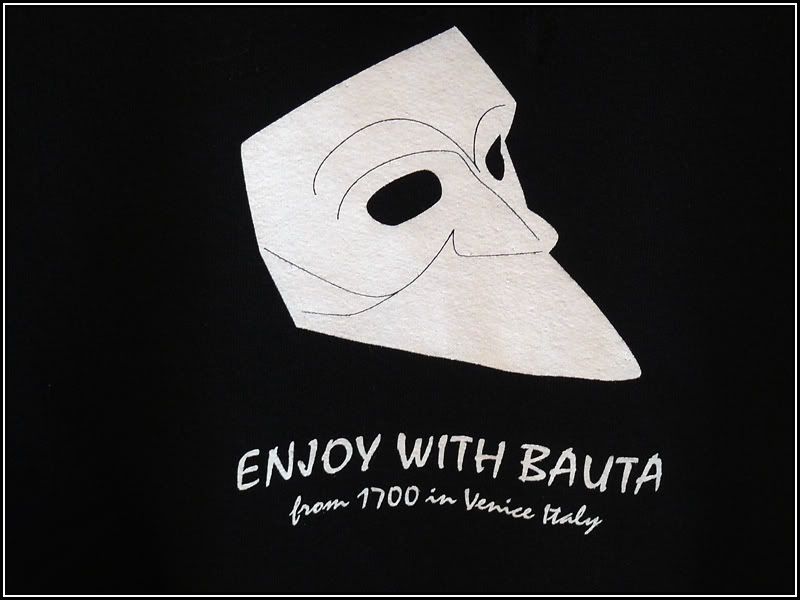

    The Bauta (La Bauta)

    The etymology of Bauta is uncertain: Tramatar believed it may be derived from the German verb "behüten", that is to protect (the wearer). Alternatively, Durante and Turato refer to the Veneto-Italian "bau-bao", which was a bogeyman like character used by adults as a method to scare children (Danilo Reato). "Se non stai bravo viene il babau e ti porta via." - (trans. "if you do not behave, the babau will come and take you away"). The original elements of the Bauta disguise comprises of the typically shining white face-shaped mask ("larva" or "volto"), a black cape or veil of silk, a cloak (tabarro) or mantle, and a three-cornered ("tricorne") hat. The Bauta was worn by both Venetian ladies and gentlemen alike.

    The most traditional type of costumes worn during the long history of Carnival included longnosed masks in black or white, a black cloak or white veil, and a tricorn hat.


    The “bauta” is typical mask in Venice during XVIII century. This mask could be wore both during carnival and normal life as common accessory. For many historiographers, Word bauta come from children claims "bau-bau" and for other historians, from "bava" the name of cone of lace in Venetian dialect.

    Bauta

    This is a "mask which covers the whole face, with a stubborn chin line, no mouth, and lots of gilding.One may find masks sold as Bautas that cover only the upper part of the face from the forehead to the nose and upper cheeks, thereby concealing identity but enabling the wearer to talk and eat or drink easily. It tends to be the main type of mask worn during the Carnival. It was used also on many other occasions as a device for hiding the wearer's identity and social status. It would permit the wearer to act more freely in cases where he or she wanted to interact with other members of the society outside the bounds of identity and everyday convention. It was thus useful for a variety of purposes, some of them illicit or criminal, others just personal, such as romantic encounters.
    There are many kind of typical masks. One is "servetta muta" (the silent maid) and this is a little black mask for women with a button to be kept only with the mouth.


    Another one has a long nose contained filter prepared with aromatic plants to send away the awful smell of the water from the channels during historical times. Other traditional masks were some masks which were wear by man in the purpose to be disguise with female clothes. 
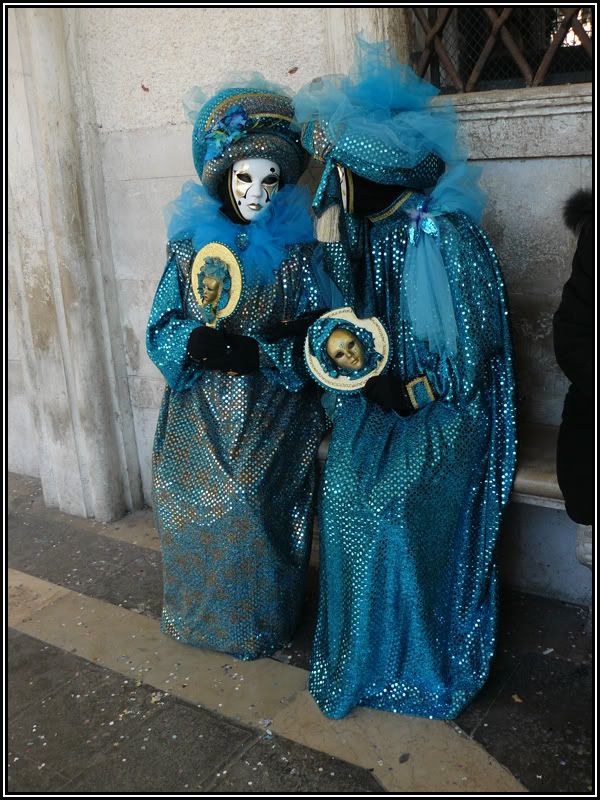


    Strange old times, adventurous lifestyle!


    Commedia Dell'arte


    Commedia Dell'arte (trans. "comedy of professional artists" or "comedy of humours"), also known as Extemporal Comedy, was a form of improvisational theatre which began in the 16th century and continued to be widely popular up until the 18th century. The performances were improvised by each theatre company around a repertory of stock conventional situations, which tended to revolve around the topics of adultery, jealousy, love and old age.
    • Abadea is the fool who laughed at nothing.
    • Arlecchino (French: Arlequin, English: Harlequin) typically depicted in multicoloured costume comprised of diamond shaped patterns. Painted by Antoine Watteau,
    • Brighella (French: Brighelle), a cunning and mischievous servant. He is associated with Bergamo.
    • Colombina (French: Columbine), maid-servant counterpart of Arlecchino (Harlequin).
    • Il Capitano (the Captain), Cap. Bonbardon, Mala Gamba, Belavita & Zerbino are just some examples of the many forms of the character and Italian masks depicted in the series of 24 etchings, Balli di Sfessania (cerca. 1621) by Jaques Callot.
    • Il Dottore (the Doctor, usually called Dottore Balanzone,  Balordo or Graziano). He is associated with Bologna.
    • Innamorata (the Lover) is the leading woman. She wore no mask (see innamorati).
    • Innamorato (the Lover) is the leading man. He wore no mask (see innamorati).
    • Isabella (Lucinda, Cornelia, Silvia, Rosaura) is Pantalone's daughter.
    • Mezzetino (equivilent of Mezzetin the French figure), painted by Antoine Watteau).
    • Pagliaccio (the Clown).
    • Pantalone or Pantalone dei Bisognosi, (French: Pantalon, English: Pantaloon). He is a Venetian Merchant
    • Pedrolino (or Pierino, most commonly nowadays known as French: Pierrot)
    • Pulcinella (related to the Italian: pulcino or chick) is a crooked-nosed hunchback. He was the model for Punch in the English puppet theatre Punch and Judy. He is associated with Naples.
    • La Ruffiana (Old Woman) is usually a mother or gossipy townswoman who intrudes into the lives of the Lovers
    • Scaramuccia (French: Scaramouche) a roguish adventurer and swordsman who replaced Il Capitano in later troupes.
    • Zanni is a threadbare old servant from Bergamo. He is associated with Bergamo & Venice.


    The Winged Lion of Venice


    Every city has its distinction; its mark on architecture. For Venice, Italy that mark of distinction is a winged lion. Why a lion when Venice is a maritime city? The symbol does seem an oxymoron but its roots lie deeply in history.


    The winged lion was at first St. Mark’s symbol but was later used as the Medici family’s way of showing the power of Venice. Legend tells us that in the Ninth Century some adventurous Venetian thieves stole the remains of St. Mark the Apostle from Egypt. They smuggled the body onto the ship by stuffing flowers and sow meat around the body so as to keep onlookers away. Soon they made it to the vessel and prepared for sail. No sooner than they had made it to the open water, a storm took hold. It was then that St. Mark “appeared” to the captain and warned him to strike the sails lest the ship crash on the rocks. They survived the storm and reached their intended destination. Local Venice religious authorities elected St. Mark as the patron saint of Venice and the winged lion (St. Mark’s traditional symbol) as the logo of the Venetian Republic.


    The winged lion, which according to the vision of St. John in the Book of Revelation is the symbol of St. Mark, became the emblem of the city and is to be found everywhere to look after the Venetians. The winged lion is a symbol of peace and is seen in a multitude of other locales such as the Assyrian temple, the Gates of Xerxes at Perespolis, and the Winged lion of Babylon. Today tourists can see winged lions not only as a Venetian symbol of power and prestige, but as a part of the rich heritage and mystique of the city. 


    Venice -the Laguna of Love-

    It is well known Venice is a town which is define through romance, it's a town of supreme love but also is the town of deepest and cruel love’s betrayals. Of course, this town has many legends and stories. If the stories are true or not is doesn’t matter, Venice still remain a mysterious and very attractive place.


    The Gondolier (oarsman) under a Venetian law, must have been born in Venice to become a Gondolier. The oar is held in an oar lock known as forcola. This oar has a complicated shape that allows the Gondola to be steer precisely. It is useed for going forward, turning, slowing down and rowing in reverse. The front ornament known as Ferro has to purposes besides being an ornament; one purpose, is to protect the front from an accidental damage, and the other purpose is to counterweight the front with the back as the Gondolier steers in the back.


    Another local legend promises eternal love to couples that kiss in the Gondola under every bridge in Venice, specially the “Bridge of Sighs”. Of course, the bridge of sighs could remind about the agony of love of Casanova - eternally lover.

    The Bridge of Sighs (Italian: Ponte dei Sospiri)

    This is a bridge in Venice, northern Italy. The enclosed bridge is made of white limestone and has windows with stone bars. It passes over the Rio di Palazzo and connects the old prisons to the interrogation rooms in the Doge's Palace. It was designed by Antoni Contino (whose uncle Antonio da Ponte had designed the Rialto Bridge), and built in 1602.  The view from the Bridge of Sighs was the last view of Venice that convicts saw before their imprisonment. The bridge name, given by Lord Byron in the 19th century, comes from the suggestion that prisoners would sigh at their final view of beautiful Venice out the window before being taken down to their cells. In reality, the days of inquisitions and summary executions were over by the time the bridge was built and the cells under the palace roof were occupied mostly by small-time criminals. Also, they could barely see any view from inside the Bridge due to the stone grills covering the windows.


    Those legends makes Venice to be another city of love. There is one legend who tell us Venice has appeared from the water. Unfortunately, this city has an unsure future: the town is sinking into the sea. It seems, this town has the curst and the honor of hard times, but who know, the power of love will save the city.


    Saint Mark and the Fisherman

    Near the Palace of the Doges in Venice there is a wide marble bridge which is crossed by hundreds of busy feet all day long. But few of the people who pass that way ever notice a little marble picture, close to the pavement, tucked away into a corner of the bridge. It is the picture of a gentle-faced Madonna with her Baby, and underneath are two quaint-looking boats, with some words cut out in the marble.

    Sometimes when a gondola goes gliding under the bridge some one with noticing eyes will see the little marble picture and ask the gondolier why it was put there.

    "Signorina," says the gondolier, "there is a wonderful and true story about that little Madonna. I cannot tell you the story now because there is so much noise and confusion in these little canals. But some night when we are out on the great lagunes I will tell you why the Madonna and the boats are there."

    And this is the story which the gondolier tells under the stars, out on the calm, still water of the lagunes. The far-away lights of Venice shine like a circlet of diamonds with their long reflections in the calm waters. The world seems to our eyes like a crystal globe, for who can tell where the sky begins and the water ends, or which are the most real, the stars overhead, or their twin reflections below? The fireflies come out and breathe and vanish and glow again. A little flame of blue fire breaks the surface of the water as the oar dips down. There is magic in everything around, which well befits the telling of the old Venetian legend.

    Long years ago there lived an old fisherman in Venice. He was an honest, hard-working old man, who had nothing in the world but his nets and his fishing-boat. But what more would you have?

    At night he tied up his boat under the wide, white bridge, and slept there snugly until the morning. It was as good as a marble palace to him.

    Of course there were storms in winter, but his boat was always safe in the shelter of the bridge until one terrible night.

    The winter was almost past, for it was in the month of February, when a storm burst over Venice, such as no one had ever seen before, and no one has ever seen since. For three days the storm raged, and the waters rose higher and higher until it seemed as if Venice would be swept from her foundations.

    The old fisherman in his little boat was moored as usual under the bridge, but the mad swirl of the waters broke the moorings and he was swept out into the open, and only managed with great difficulty to reach the steps by the Riva of San Marco. There he landed wet through and greatly fearing what would happen next. There was nothing to do but to sit down and wait patiently for the storm to cease, while the angry waves beat against his little boat, and the night grew darker and darker.

    Presently, as he sat there alone, a man came down the steps and stood beside him. The old fisherman knew most of the Venetian people by sight, but he had never seen this man before.

    "Fisherman," said the stranger, "wilt thou row me across the water to San Giorgio?"

    Now the island on which San Giorgio stands was not far off, but between was a grey belt of raging waves lashed ever higher and higher by the fierce gathering storm.

    The old fisherman pointed to the waves and then to his little boat.

    "How can I row thee across?" he shouted, for he needs must shout to be heard above the roar of the wind; "my boat would be dashed to pieces in a moment, and we would both be drowned."

    "I must reach San Giorgio to-night," said the stranger, "and I will pay thee generously."

    Well, seeing it was the will of heaven and hearing that he would be well paid, the old fisherman entered the boat with the stranger and managed to push off from the shore. What then was his amazement to find that it was quite easy to guide the boat. The tempest still raged around him, but the waves seemed to spread themselves out in a smooth pathway before them.

    It was not long, therefore, before they reached San Giorgio, and there the stranger landed, bidding the old fisherman wait for him.

    Presently the stranger came out of the church again and with him came a young knight. He was straight as an arrow, upright as a dart, and his face was very good to look upon, it was so brave and beautiful.

    Both the men entered the boat, and the stranger, turning to the fisherman, said quietly, "Now, thou shalt row us over to San Niccolo di Lido."

    "But how is that possible?" cried the old fisherman, throwing out his hands. "Even were it fair weather it would be impossible to row so far with but one oar."

    "It shall be possible for thee," answered the stranger calmly, "and remember thou shalt be paid generously."

    Well, the fisherman looked at the wide stretch of angry waters and then at the quiet face of the stranger, and took up his oar again.

    "We shall certainly all be drowned," he said. But he pushed off once more and set out in the direction of San Niccolo di Lido.

    And just as it had happened before, the waves spread themselves out smoothly under the little boat, and the fisherman rowed without the slightest difficulty until they came to San Niccolo di Lido.

    Then both the men got out, again bidding the fisherman wait for them.

    This time they came back with an old man, dressed in the robes of a bishop. He had a kind, gentle face, and even to look at him comforted the heart of the frightened old fisherman.

    "Now, row to the gates of the two castles," said the stranger, when all three were safely in the boat.

    "But that is the open sea," said the fisherman, trembling with fear; "we shall be certainly overwhelmed."

    "Row boldly," said the stranger, "and fear naught."

    The winds howled and the waves roared, and the tempest shrieked louder than ever. It seemed impossible that a little boat could live in such angry waters.

    And lo! when they came to the gates of the sea, a terrible sight met the eyes of the old fisherman. Sweeping down upon them, full in front, was a huge ship or galley with all sails set. The ship was crowded in every corner with black demons whose shrieks rang even louder than the scream of the wind.

    On and on they came, tearing through the waves, and the old fisherman fell on his knees and began to say his prayers, for he thought in another moment his boat would be swallowed up.

    But the stranger and the knight and the old bishop rose to their feet, and with uplifted hands they calmly made the Sign of the Cross as the demon ship came near. Instantly the waters grew still, the wind dropped, and the demon ship disappeared with a sound like the crack of thunder.

    "Now row us back from whence we came," said the stranger.

    And the trembling old fisherman obeyed, wondering greatly what all this could mean. One thing he felt sure of. That demon ship had been on its way to overwhelm and destroy Venice, and he rejoiced to think his beloved city was now safe.

    So back they went to San Niccolo di Lido, and there they left the old bishop; then on to San Giorgio, and there the brave knight silently landed.

    But when the old fisherman rowed back to the Riva di San Marco, and the stranger was about to land, he began to bethink himself of the promised payment.

    "Miracles are wonderful things," he said to himself, "but I want something more than miracles."

    So he stood with his hat in his hand, and asked the stranger to pay him as he had promised.

    "Thou art right," said the stranger. "I must not forget thee. Thou shalt be well rewarded. Dost thou know for whom thou hast worked to-night? I am Saint Mark, the patron saint of this city. The young knight we took with us was the brave Saint George, and the bishop was none other than the good Saint Nicholas. Together we have saved Venice. For had it not been for us the demons would utterly have destroyed her. To-morrow thou shalt go to the Doge and tell him all thou hast seen, and how Venice was saved with thy help, and he will reward thee."

    The old fisherman shook his head.

    "And how will the Doge know that I speak the truth?" he asked. For though he held Saint Mark in great reverence, and felt how great an honour it was for the saint to talk with him, he still felt a little anxious about the payment.

    Then Saint Mark drew a ring off his finger and handed it to the old fisherman.

    "Take this ring," he said, "and show it to the Doge, and tell him I gave it to thee. Then should he still doubt thy word, bid him look in the treasury of San Marco, and he will find the ring is no longer there."

    So the old fisherman took the ring and thanked the Saint. And the next day he went as early as possible to the Doge and told him the whole story of what had happened, showing him the ring.

    The Doge sent quickly to search in the treasury for the Saint's ring, which was always kept there, but they found it had disappeared. So they were sure that it was Saint Mark himself who had given it to the old fisherman. Whereupon there was a great thanksgiving service held in Venice, and a solemn procession went to each of the three churches, where the bones of the saints were enshrined.

    The old fisherman was not only rewarded with gold, but a certain privilege was granted to him. He alone was allowed the right of selling the silver sand from the shore of the Lido. So he grew richer than any fisherman in Venice, but in spite of his riches he always lived in his little boat under the white marble bridge. And when he died the city rulers ordered that little marble picture to be made, with the boats carved beneath it, in memory of the old fisherman who had helped to save Venice that terrible night from the vengeance of the demon crew.

    Mărțișor

    March The 1st: “Mărțișor”

    The tradition has it that the spring and summer weather will be just like the one from this day. March the 1st is related to the custom of “martisor” (diminutive form of martie = March). Folk beliefs say that who wears the “martisor” will be lucky and healthy.

    The Little March Amulet

    Mărţişor is the symbol of spring and also a celebration on the first of March. Its beginnings are still a mystery. The first evidence of a similar custom come from 8000 years ago. The archeologist have discovered small river rocks painted in red and white that were probably string on a rope and wear as a necklace. Also in ancient Rome, New Year's Eve was celebrated on the 1st of March (Martius), the month of the war god Mars. He had a double role: both protector of agriculture and of war, so the celebration signified the rebirth of nature. The duality of symbols is kept in the colours of the Mărţişor: white and red, meaning peace and war (it might also symbolize winter and spring)
    In the old times, the “martisor” was made of two woolen threads, a white one and a red or black one, symbolizing the two main seasons , winter and summer. Women used to make this braid, which they tied on the wrist and neck of their children.

    The “martisor” was also worn by young men and adults. Moreover, the braid which announced the spring was tied on the horns of the cows or on the gate of the stable, in order to protect the household. In the old times, March the 1st was the beginning of a new year, moment in which people needed to protect themselves from the evil spirits.

    Later, a silver or golden coin, or even a medallion was hanged of the braid, having a protective function. The coins of that braid were kept until St. George (April 23rd) and the girls were buying themselves fresh cheese and red wine, in order to blush as the wine and to be as white as the cheese.

    The  “martisor” is worn until the roses or the cherries bloom. Then, the braid is tied on one of the branches of that tree. In other regions, the “martisor” is worn during the ”Old Woman’s days” (March 1st - March 9th), after this being tied on a tree. It is believed that, if the tree gives fruits, the man who has worn the “martisor” will be lucky. If the “martisor” is thrown after a bird, the man will be as easy as that bird.


    The Story of the Little March


    Once upon a time, there was an old woman. She had a son, March, who had just got married. The old woman didn't like her daughter-in-low maybe because she was too beautiful. That is why she was trying to find a flaw in her son's wife ordering her the most difficult jobs. 

    One day the old woman commanded the girl to go to the river and to wash some black wool until it would become white. Without a word the young woman went to the river. There a young man appeared miraculously. He immediately turned the black wool into white one. When he wanted to thank him he disappeared leaving no trace behind him.
    Another time, at the end of the winter, in February, the bad old woman asked her daughter-in-low to bring her some wild strawberries. The girl had no choice but to go find the wild fruits. March was desperate because his own mother was torturing his wife. That is why he left his home.
    Crying, the girl wandered throws the forest and suddenly the same handsome young boy appeared and filled up her basket with wild strawberries.
    The young lady hung at her neck a white coin for the wool and a red one for the wild strawberries.  In her husband's memory whom she is still looking for, she called the coins "Little March". From that day all the "Romanian girl and women wear Little Marches". They believe that the Little Marches bring them luck in love and good health.  


    The Legend of the March Amulet


    Once upon a time, the Sun embodying a handsome young man, got down from the sky to dance a Romanian round dance (hora) in a village. A dragon lay in wait for him and kidnapped him from among the people and threw him into a jail. The world got sad. The birds wouldn’t flow and the children wouldn’t laugh.  No one dared to challenge the bad dragon. But one day a brave young man decided to go and save the Sun. Lots of people saw him off and shared their strength with him. So they helped him defeat the dragon and save the Sun. His journey lasted for three seasons: summer, autumn and winter. He found the dragon’s castle and they started to fight. They fought for days and finally the dragon was killed.
                                 
    Powerless and wounded, the young man set the Sun free. The Sun rose in the sky cheering up all the people and filling them with joy. The nature revived, the people got happy, but the young man couldn’t live to see spring coming. The warm blood from his wounds dropped on the snow. While the snow was melting white flowers, called snowdrops, messengers of the spring, were appearing out of the snow. Even his last drop of blood dripped out in the immaculate snow. And he died. Since then the young people have been knitting two little tassels: a white one and a red one. At the beginning of March, they offer this amulet to the girls they love… Red means love for everything that is beautiful. It reminds us of the color of the brave young man’s blood. White symbolizes the pureness and health of the snowdrops, the first flowers that appear in spring.


    Dracula Myth vs. Legend, Story vs. Reality

    Romania – the land of vampires

    When referring to Romania the first thing that comes to mind is Transylvania. Home to some of the best preserved medieval towns in Europe, most relating to the legend of Dracula. This is the reason why, for many foreigners, Romania is the land of Dracula. Although,  not as popular at home us he is abroad, Dracula has become a tourist attraction. Many people come to Transylvania seeking his trail, and many go away again disappointed.


    Where does Dracula come from?


    Did you ever wonder how the legend of Dracula came to be known and why it belongs to Romania? Besides the impressive story of Vlad the Impaler there are other important elements that build the legend. Perhaps one of the main reasons Romania is considered the homeland of vampires ist hat there are several legends that are centered on vampires.

    One of the most important is the myth of Nosferatu- the illegitimate child of illegitimate parents. It is said that his name comes from the Greek nosophoros which means plague bearer of from the old Slavic word nosifor-atu or nesuferitu (obnoxious).

    But Nosferatu didn’t feed with human blood. Its main feature was its libido, he being able to be intimate with the living. However, he made his victims-mistresses sick. Their fatigue evolved soon into a disease with symptoms similar to those of tuberculosis.

    Nosferati, for there wasn’t only one, could also conceive this is why they were considered dangerous to young married couples; their hatred for those legally married making them to leave the young wife pregnant with their offspring.

    Nostefati’s portrait is totally different from what we know today about vampires. The inhabitants of the Carpathians considered them to be highly sexual creatures that had nothing of the following features:  blood-drinking, fang-wielding, daylight and crucifix-fearing. This portrait has, unfortunately, no relation with the original Romanian legends, but in part with Bram Stocker’s novel.

    dracula1Other very important legends are those of Moroii and Strigoii. These two are seen in close connection. The essential difference between them being the fact that Moroii are living vampires while Strigoii retourn from the dead. Moroii can also be both women and men and have all the characteristics that Strigoii have. Among the ways a person can become a Strigoi there is suicide or the fact that the dead person is the seventh son in the family. There is also the theory that if a pregnant woman drinks impure water or gets out of the house at night with nothing to cover her head the Evil One will appear and will put a red chitie on the head of the baby. This should be removed as soon as possible in order to prevent the transformation of the child. Although there are several versions of the origins of these mythological creatures: Strigoii and Moroii both have one common characteristic: they hurt their victims. However, only in some areas they are assimilated to the notion of vampires.

    Varcolacii are other fantastic figures and they are considered to be the strongest type of undead. They are so strong they can eat the Moon and the Sun, making them disappear. They too appear when an unbaptised child dies. Their name seems to come from Bulgarian and Serbian vylx + dlaka meaning wolf hair. However these creatures don’t attack people directly so they are loosely connected with the vampires.

    Morii, Varcolacii,Strigoii and the Nosferatu have contributed to the development of the vampire legends on the Romanian territory, influencing creativity all around the world and generating more and more new legends and interpretations, like the most recent Twilight saga.


    The Fictional Count Dracula

    Vlad the Impaler
    Who is Dracula and what connexion  does it have with Transylvania? - this is the main question when somebody wants to discover the real story of legendary character.  

    When one hears the name Dracula, most are inclined to think of a Hollywood fairytale with blood sucking vampires and a fictitious Count Dracula. This is true in one sense and completely false in another.

    The figure most people associate to Dracula is a fairytale, written from the pen of Irish Novelist Bram Stoker. Many believe Stoker based his novel on the real life figure, Vlad Tepes III. Vlad was a prince of Walachia, located in central Romania. This is where the similarities end, as Stoker never actually visited Transylvania, or Walachia, and merely drew images from the stories written in European papers at the time.

    Vlad Tepes was born in or around 1431, in the Transylvanian town of Sighisoara. Today you can visit the house in which Vlad was born, which has been restored to its original condition, and enjoy one of the best preserved medieval citadels in Europe. Prince Vlad III was named Drăculea by his contemporaries. This was because his father, Vlad II was invested by the Emperor Sigismund in Nuremberg on 8th February 1431 with the Order of the Dragon. This chivalric order was a military and religious society whose aims was to stop the expansion of the Ottoman Empire. The arms of the Order depicted a dragon (symbol of the Ottomans) and a cross (symbol of Christianity) in Romanian the word for “Dragon” (“Drahe” in German) is “Drac” (“Devil” in Romanian language) and so Vlad added the epithet “Dracul” (“The Dragon”) this name and his descendents  were named “Drăculești” : Vlad III was “Drăculea” (i.e. “Son of Dracul”).


    At the time Vlad was in power, Walachia was a main trading route, and a strategic Vlad Tepes (The Real Dracula) point in the battle between the Turkish, Invaders from the East and the Hungarian throne situated in Budapest. This caused a very turbulent situation, as the battle of religions with these powerful neighbours was often fought on these lands. Vlad was known for many things, most of which being his cruel and ruthless torture methods.

    Impalement was Vlad's favourite form of punishment, and he held no favourites, whether it be local thieves, foreign nobleman, or the sick and poor. As stories vary from one person to the next, the true life of Vlad Tepes will never be known. The printing press releases from Germany and Russia have similarities to the stories and life of Vlad, and local folklore is probably the best way to find out more on Vlad's life.
    Certainly, it was only the exaggeration of Prince Vlad – The Impaler’s cruelty by malicious chroniclers that led, over time, to the creation of the Dracula myth. A series of chronicles inspired by the life of Vlad The Impaler paint a macabre picture of the prince, who was wont to punish treachery, dishonesty, stupidity, laziness, lying, thievery,  corruption and flattery by impalement, bunging, flying, decapitation, boiling alive, blinding, crucifixion, stabbing and strangulation. Likewise, victims were buried alive, burned, roasted, maimed, or bad their nose, ears, tongues or genitals amputated.

    The figure of The Impaler has remained emblematic for Romanians, in spite of the exaggerations  regarding his limitless cruelty. Legends have grown up around him: strange as it might seem, during his reign a golden cup stood at the edge of a fountain in the centre of Târgoviște, without ever beeing stolen.  Many things can be said of Vlad The Impaler: that he was cruel, and merciless, although just and courageous; that he knew no pity, although he was a  “voevod  concerned with people and nation”. The chronicles mention nothing of the monasteries and churches founded by Vlad The Impaler:  Comana (1461), the Churches of Strejnicu and Târgușoru Vechi (1461).  Although inexplicable his identification with a vampire-count, a personage inspired by horror films, has brought Vlad The Impaler an unexpected tourist celebrity. The bloody Drăculea has become a product perfect for “frightening” and “attracting” the tourists.

    Vlad Tepes was the Romanian character that is the most famous in Europe and not only. He was the main character in the literary production from the second period of the XVth century in the Eastern Europe and Western Europe. Unfortunately this fame is a negative one and it shows the great leader as the symbol of the evil. How did such a complex personality end up to be such known when he was still alive?

    The origins of his image are being pointed out by the nickname he was given “Tepes”, as he is known in the Romanian history. The nickname appears first in the Turkish chronicles of the XVth century and XVIth century. He is named as Kaziklu bey (the prince that impales). Vlad was given this nickname because of the cruel method he had chosen to execute the war prisoners, the convicts and the adversaries. Vlad Tepes was a descendent from the Dragon Order, known as The Draculestilor Order. In German language the Dragon Order is called Drachenorden and in Latin is called Societatis draconistrarum. It was a like any other knightly orders of the time, having as a role model the “Order of St.George” built in 1318. Like his father, Vlad Tepes was a member of the Dragon Order. A proof of this is the signature he used to sign on official documents of the time: Dracula. Along the centuries this signature gained unexpected meanings.

    The name Dracula was rapidly spread in all Europe of that time. In the Turkish language it was known under the name of Kazîclî; the Pec Bishop called it Dracole; Dan a knight who wanted the Romanian throne called him Dracul (Devil); in the Serbian annals before 1462 appears as Dracula; in the German story until 1462 appeared as Dracal or Dracao; the bishop Nicolae de Madrussa called him Dracul; the Venice Senat – Dragulia sau Draculia; the Hungarian king Matei. On purpose or not, the name of Vlad Tepes together with his behaviour brought him a great fame. His special skills and qualities along with his actions brought him a special place in the Romanian tradition not as a bad character but as a Robin Hood character. He was unmerciful with the rich people that broke the law and a good friend to the poor people.

    For the Romanian land peasants he was the national hero that served their cause. He became famous because of the so called German stories that tried to denigrate the great leader. He is presented here as an antichrist, a criminal, a cannibal (an engraved stone shows him in the middle of the a spike forest waiting for his subjects to serve him human organs). This campaign was coordinated by the Hungarian king Sigismund de Luxemburg, who had to justify the desertion of the crusade against the Ottoman Empire, as he was given important help from the Roman Pope.

    Illustration from German chronicles of the time.

    This is a scene of the impalement. Vlad Tepes aka Vlad the Impaler  is watching the operation from a table, having his lunch and drinking wine. The picture is not necessary relevant to the image of Romanian prince, because the Germanic sources was affected by the myths and political interests.
    As Vlad Tepes had organized himself a campaign against the Ottoman Empire, well seen by the Pope, Sigismund’s action was received very well. He paid for some false writings against the Wallachian leader.This falses include: The manuscript from Viena, incorporated in the Chronichle of Thomas Ebendorfer, the comments of Enea Silvio Piccolomini, the next to be Pope under the name of Pius the II (1458-1464), the verses of MichaelBeheim. From all the documents, the verses of Michael Beheim from 1462 – 1463: “About a tiran under the name of Dracula from the Romanian land” seem to be the most complex with 1070 verses. It is a synthesis of the German stories about Vlad Tepes, having a very powerful and eloquent ending. 950 of the verses describe the cruelties of him and in the other verses the horrible betrayal that led rightfully to his arrest. Being at the wrong time in the wrong moment Vlad Tepes was transformed from a great political and military personality of his time into a criminal of the history. The concept of “vampire” has the meaning taken from prehistoric times when the man being a hunter discoveredthat when an animal is killed and his blood drains’ from his veins, his life ends. The blood became in the mind of the hunter the source of life That is why some tribal members used to drink the blood of the animals killed, in order to claim their vitality. This practice was extended until the middle ages, where the prejudices of the Christian church turned this ritual practice from the life to the dead, and so the vampires appeared. As one of the most frequent phenomenon of the world history, the vampires had left their “fingerprint” on history since antiquity. From the Egyptian culture, from the Greek culture (the first wife of Zeus, Lilith, was considered to be a vampire), and from the Jewish culture until the far East to the Japanese (where are the vampire animals), the vampires have fascinated and intrigued the human society.

    http://www.produsin.ro


    Dragobete, Romanian Celebration of Love

    While Valentine’s Day is mostly related to people (a saint and those he helped) and their actions in the name of love, the Romanian holiday dedicated to love, Dragobete, is strongly connected to nature. Celebrated on February 24th, it is linked to that special time of year when birds build their nests and mate. As the first signs of spring show, nature and man restart the cycle of life and love. What better reason to celebrate? What better reason to sing, dance and kiss girls?

    Dragobete, also named Dragomir, is the local counterpart of Roman god Cupid and Greek god Eros. He isn’t however mentioned as a divine creature. He is a positive character, a symbol of pure love, completely opposite to his mother, Dochia. Dochia is said to have been a very cruel mother in law, making a habit of mistreating her daughter in law. She sent her to pick up berries in the month of February, an impossible time of year to find such fruit. God helps the girl in her task fact that leads to a tragedy.

    Dochia, believing it was spring already, takes her sheep and her son, Dragobete, up the mountain. Although she carries 12 lambskins in the beginning of her journey, she looses them. The story has two versions here: they either get wet because of the rain or she throws them as it was very warm. Both Dochia and her son freeze to death on the mountain.

    However, I like happier myths about who the mother of Dragobete was. One version of the story is of a proud woman, teasing the month of March who then gets even by taking a few days from February. Other stories are of Dochia, sister of Dacian ruler Decebal, who runs away in the mountains to seek refuge from the Roman Emperor Trajan. She disguises herself as a shepherd, but looses her lambskin and freezes. She is then metamorphosed into a stream and her sheep are turned into flowers.

    Regardless of its origin, the myth of Dragobete speaks of pristine love, of nature’s rituals translated into people’s life, of new life cycles and of being reborn. It is also said that couples are watching out for which one of them is stepping over the others foot. It is believed that he or she will then take the lead in the couple. 

    In the past, on the Dragobete day, the villages  began to play: every boy chasing a girl , she get caught by one she love and even engaged to him. Thus, "Dragobete kissing girls" became the well-known saying.


    http://www.rounite.com/2008/02/24/dragobete/